

Categories List
Recent Posts
 1.5 HP 3.5KW Explosion-Proof Split Air Conditioner | ATEX Gas & Dust — BKT-3.5 (F)The BKT-3.5 (F) is CNWINNEX's split wall-mounted explosion-proof air conditioner for single-room hazardous areas. Rated 1.5 HP, it delivers 3500 W of cooling and 3850 W of heating at an air volume of 600 m³/h, operating in ambient temperatures from -7 °C to +55 °C, with R410A refrigerant. Both the indoor and outdoor units are built to explosion-proof construction.
The defining feature of this generation is the dual protection system. On the gas side, the unit combines three protection concepts — flameproof enclosure (db), intrinsic safety (ib) and encapsulation (mb). On the dust side, it uses protection by enclosures (tb). Both markings are headed by the hexagonal Ex symbol reserved for equipment certified under the EU ATEX Directive 2014/34/EU.
Ex db ib mb IIC T4 Gb (Gas: Zone 1 / Zone 2)
Ex tb IIIC T130 °C Db (Dust: Zone 21 / Zone 22) 90° Curved & 180° Folding Explosion-Proof Barrier Gate | CNWINNEXThe EGDZ curved and folding arm explosion-proof barrier gate solves one problem: there is no clear straight run beside the lane. The 90° curved arm stands up along a wall or a piece of equipment once raised; the 180° folding arm doubles back on itself. Both control access where a straight boom cannot physically be installed. Cabinet, mechanism, motor and control unit are flameproof, rated for Zone 1 and Zone 2 areas with Group IIA, IIB or IIC gases.
These are not edge-case specials. Retrofits, process-unit densification, underground factories and jetty decks all share the same condition: the space is already occupied by equipment. The post position is fixed, the pipe rack height is fixed, the available clearance is fixed. Changing the site means shutdown, civil works and re-approval; changing the bar type means changing one drawing. 6m Long-Boom Explosion-Proof Barrier Gate | ATEX Zone 1 | CNWINNEXThe EGDZ long-boom explosion-proof barrier gate is the widest-opening configuration in the CNWINNEX range: a single arm up to 6 m, spanning a two-way lane and replacing the conventional pair of opposing units. Cabinet, mechanism, motor and control unit are flameproof, rated for Zone 1 and Zone 2 areas with Group IIA, IIB or IIC gases.
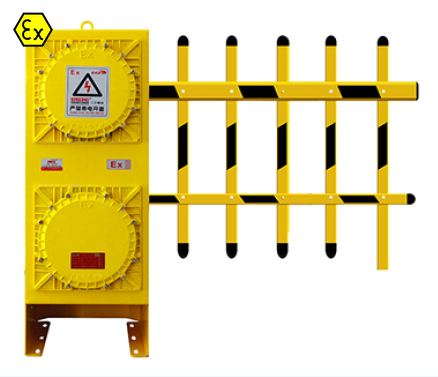
The engineering difficulty is not making the arm long; it is keeping a long arm stable. Double the length and rotational inertia rises with the square, so tip deflection, swing during travel and impact at the end stop all scale up. The same 160 W brushless motor driving a 3 m arm and a 6 m arm represents two different design problems.- Fence-Type Explosion-Proof Barrier Gate | ATEX Zone 1 | CNWINNEXThe EGDZ fence-type explosion-proof barrier gate is the variant in the CNWINNEX range built for sites where people and vehicles share one entrance. The cabinet, mechanism, motor and control unit are flameproof; the boom is a two-rail or three-rail fence section, so it stops vehicles and also stops anyone trying to duck under or climb over the arm.
It answers the hardest kind of hazardous-area entrance: staff walking through during the day, tankers entering at night, and no continuous wall on either side. A single straight boom at that location covers only half the risk. A fence section drops to form a continuous barrier roughly one metre high, and lifts as one piece, so vehicle speed is unaffected while the gaps for crawling and climbing are closed. - Atex Certified Zone 1 & Zone 2, Zone 21 & 22 Explosion-proof Barrier Gate | Hazardous AreaThe EGDZ is an intelligent, fully integrated explosion-proof barrier gate built by CNWINNEX for explosive gas and combustible dust atmospheres. The cabinet, mechanism, motor and control unit are all designed as flameproof equipment, so the complete unit — not just the control box — is rated for hazardous areas. It controls vehicle and personnel access at plant gates, process unit entrances, tank farm inlets and product loading areas.
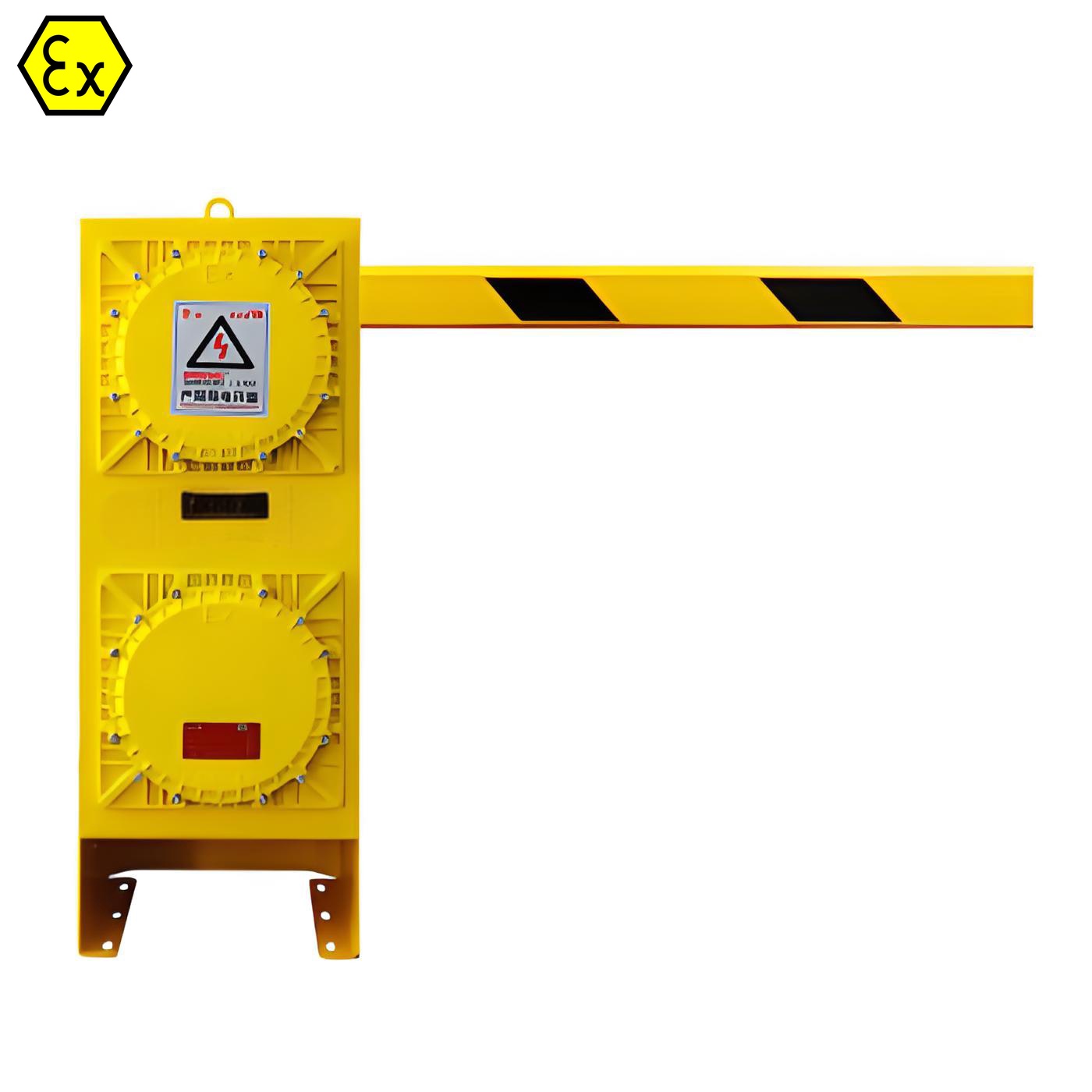
Its marking is dual. On the gas side, II 2 G Ex db IIC T4 Gb; on the dust side, II 2 D Ex tb IIIC T130°C Db; enclosure protection IP66. One unit therefore covers Zone 1 and Zone 2 areas with Group IIA, IIB or IIC gases at temperature classes T1 to T4, and also covers Zone 21 and Zone 22 dust areas — with no model change between a gas zone and a dust zone.  CNWINNEX EGDZ-M Mini Explosion-Proof Barrier GateA Warning Sign Cannot Stop a Forklift
Your LNG cylinder yard sits right next to the plant road. A forklift takes the corner too tight, a truck pulls over to wait, a maintenance worker cuts through on foot. Three warning signs and two coats of floor marking later, the risk is still there. Access control in hazardous materials storage areas has always depended on the least reliable variable in any plant: human compliance.
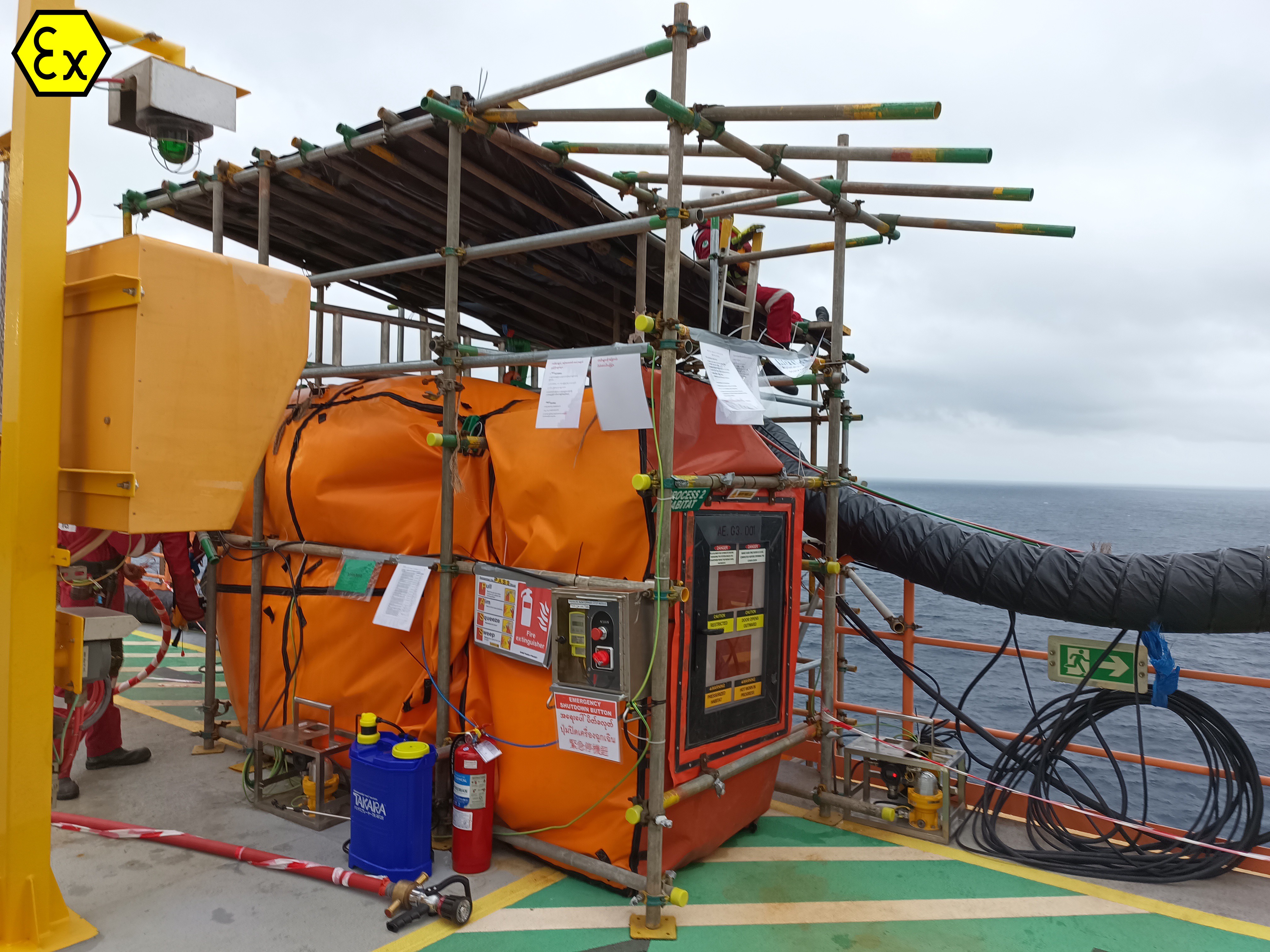
The real gap is not signage visibility. It is the absence of a physical boundary. The CNWINNEX EGDZ-M mini explosion-proof barrier gate closes that gap: a low-level boom placed across the storage-area entrance or fence gap, turning "no entry" from a painted slogan into a physical fact. CNWINNEX Pressurized Explosion-Proof Maintenance HabitatThe CNWINNEX Pressurized Explosion-proof Maintenance Habitat is a relocatable, positive-pressure explosion-proof working space built for on-site maintenance, hot work and equipment servicing in explosive hazardous areas. The main frame is assembled from industrial heavy-duty aluminium profiles, with flame-retardant shelter panels forming the surrounding walls. The habitat is of overall pressurized explosion-proof construction, with a separate access door and buffer room as well as an emergency escape door and observation windows. Outside the shelter, two sets of explosion-proof pressurized fresh-air blower systems connect to an external pressurized fresh-air source, creating a clean working environment that continuously maintains positive pressure inside the hazardous area.
 200kW CNWINNEX Positive-Pressure (pxb) Explosion-Proof Resistive Load Bank · ATEX CertifiedThe CNWINNEX 200KW positive-pressure explosion-proof load bank is a canopy-type resistive load testing unit built around positive-pressure (pxb) explosion protection. Rated at 400Vac, 50Hz, three-phase four-wire (3P4W) with a power factor of 1.0, the unit achieves 1kW fine staging through 10 resistive load stages. Weighing only 220kg and fitted with 4 heavy-duty castors, it can be relocated and deployed flexibly in equipment rooms, workshops and outdoor sites, making it an ideal load verification tool for 200kW-class generator sets, UPS systems, energy storage systems and data centre equipment in hazardous areas.
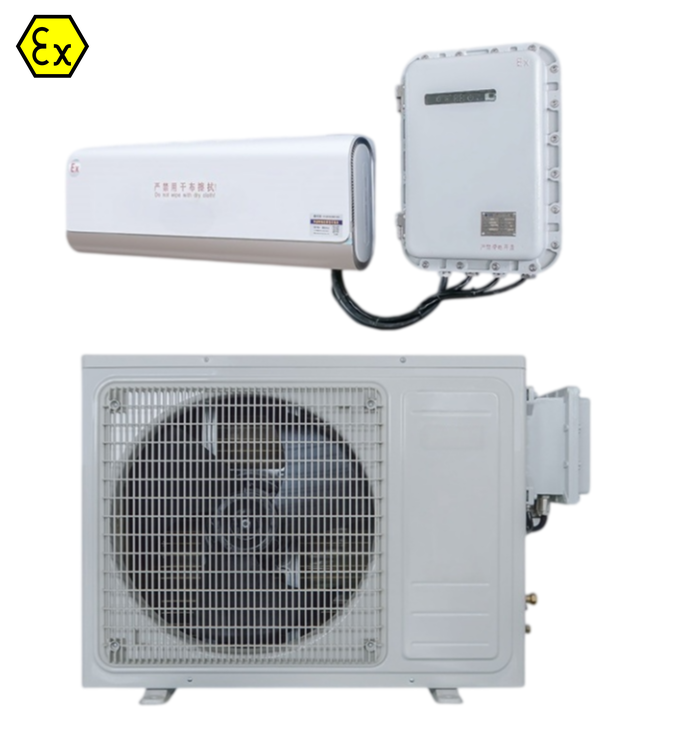

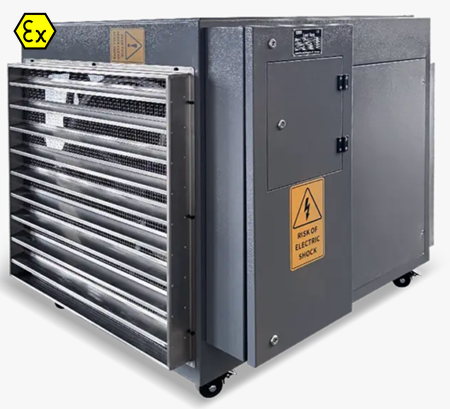

1.5 HP 3.5KW Explosion-Proof Split Air Conditioner | ATEX Gas & Dust — BKT-3.5 (F)
The BKT-3.5 (F) is CNWINNEX's split wall-mounted explosion-proof air conditioner for single-room hazardous areas. Rated 1.5 HP, it delivers 3500 W of cooling and 3850 W of heating at an air volume of 600 m³/h, operating in ambient temperatures from -7 °C to +55 °C, with R410A refrigerant. Both the indoor and outdoor units are built to explosion-proof construction.
The defining feature of this generation is the dual protection system. On the gas side, the unit combines three protection concepts — flameproof enclosure (db), intrinsic safety (ib) and encapsulation (mb). On the dust side, it uses protection by enclosures (tb). Both markings are headed by the hexagonal Ex symbol reserved for equipment certified under the EU ATEX Directive 2014/34/EU.
Ex db ib mb IIC T4 Gb (Gas: Zone 1 / Zone 2)
Ex tb IIIC T130 °C Db (Dust: Zone 21 / Zone 22)
The hexagonal Ex mark on a nameplate is not decoration. It signals that the certification follows the ATEX framework, backed by a certificate and an EU Declaration of Conformity — the difference between an air conditioner that has been "treated for safety" and one that can prove it.
2. Where a 1.5 HP Unit Belongs
Start with the room, not the datasheet. A 3500 W cooling output, estimated at the 160–220 W/m² cooling load commonly used in hazardous-area rooms, suits roughly 16–21 m². Rooms with heavy heat sources, west-facing exposure or high ceilings should be calculated individually; step up a model rather than overload this one.
The unit is aimed at the rooms every hazardous facility has but few suppliers cover: small, permanently occupied, climate-controlled spaces inside the zone. Chemical plants call them analyser shelters, duty rooms and instrument rooms. Ammunition storage areas call them storage and inspection rooms. What they share is that they are too small for a commercial central system, and too dangerous for any ordinary air conditioner.
The split wall-mounted format is the friendliest for such rooms. The indoor unit hangs on the wall and takes no floor space; the outdoor unit sits outside or on a plant deck, moving the compressor and most of the heat rejection out of the room, which reduces the indoor load and keeps the service face outside the hazardous area.
3. Reading the Dual Protection Marking
● Each element of the gas marking Ex db ib mb IIC T4 Gb corresponds to a concrete protection measure.
● db (flameproof enclosure): the compressor, fan motor and other high-power components sit in an enclosure that withstands an internal ignition and prevents transmission. The strongest ignition sources get the hardest shell.
● ib (intrinsic safety): the low-voltage signal circuits — temperature sensing, display, remote-control receiver — are energy-limited so that a spark cannot ignite the surrounding atmosphere.
● mb (encapsulation): solenoid valves, relays and contactors are encapsulated in a compound, physically separating arcing contacts from the atmosphere.
● IIC T4 Gb: all gas groups IIA / IIB / IIC are covered, including hydrogen and acetylene; maximum surface temperature 135 °C; protection level Gb, suitable for Zone 1 and Zone 2.
● The dust marking Ex tb IIIC T130 °C Db is equally complete: protection by enclosures (tb) addresses ingress and surface temperature; IIIIC covers conductive dust — aluminium, magnesium and propellant powders fall in this group; and Db permits use in Zone 21 and Zone 22.
Why does the dual marking matter?
Buyers frequently order against the gas marking alone and ship the unit to a dust environment — a flour mill, an aluminium powder plant, a propellant store. There the medium is not a gas, the gas marking does not apply, and the unit fails acceptance. One unit carrying both markings removes that entire category of rework.
4. Armories and Ammunition Storage
The dual protection system opens a category of facility that has long been difficult to cover: military armories, ammunition storage rooms, pyrotechnic and explosive stores, and commercial explosives magazines.
The need for air conditioning in these rooms is not comfort-driven. Munitions and propellants are highly sensitive to temperature and humidity: long-term storage is normally specified at room temperatures not exceeding 30 °C and relative humidity not exceeding 70% (the governing storage standard applies).
Sustained heat or moisture accelerates propellant stabilisation loss and cartridge corrosion — a direct reduction in storage life and safety. In tropical and subtropical climates, mechanical ventilation alone cannot hold those conditions; air conditioning in such stores is an assurance asset, not an amenity.
Yet these same rooms are precisely where a standard air conditioner is prohibited: the stored media are flammable and explosive, and under certain handling and leak conditions the room atmosphere can contain propellant dust — a combustible dust, in many products conductive.
This is where the dual marking earns its place: the gas marking covers unexpected vapour atmospheres, the dust marking covers the propellant dust that can be routinely present. One machine addresses both, so the store never has to choose between cooling and compliance.
For such projects CNWINNEX provides: room-by-room verification of marking applicability against the area classification drawing; temperature and humidity setpoint recommendations aligned with the governing storage standard; a full documentation package with certificates and the Declaration of Conformity; and for classified projects, an NDA with sanitised technical documentation on request.
5. Further Applications
Beyond defence and explosives storage, the dual marking carries this 1.5 HP unit into a wide list of facilities:
● Petrochemical and oil & gas: analyser shelters, sample rooms, chemical injection rooms and instrument rooms — small, occupied, permanently climate-controlled.
● Pharmaceutical and fine chemical: solvent stores, weighing rooms and retention sample rooms handling ethanol, acetone and ethyl acetate, all IIC-group solvents.
● Battery and new materials: electrolyte staging rooms and adjacent spaces, where electrolyte vapours fall into groups IIB / IIC.
● Paints and inks: tinting rooms and pigment powder stores, where gas and dust risks coexist — the exact case the dual marking was built for.
● Dust-handling industries: flour and starch processing, metal powders (aluminium, magnesium), plastics pelletising — Zone 21 / 22 environments.
● Fuel and gas facilities: convenience stores and duty rooms at refuelling stations, auxiliary rooms at tank farms and airport fuel areas.
One sentence covers the whole list: the room is inside the zone, people work in it, and the temperature must be controlled. Where those three conditions meet, this is the machine.
6. Technical Specifications
The table below lists complete unit data for the BKT-3.5 (F). Indoor and outdoor units are both built to explosion-proof construction, and the data match the nameplate.
Table 1 BKT-3.5 (F) split wall-mounted explosion-proof air conditioner
Four installation points decide most field outcomes, followed by the five questions buyers ask most.
7.1 Installation notes
Confirm both locations: the indoor room must fall within the certified area of use — and so must the outdoor unit position, which often sits inside a Zone 1 boundary on plant decks.
Power entry: supply cables enter through Ex flexible conduits and certified glands. Never drill the casing. Interconnecting and power cables run in separate conduits with drainage at low points.
Earthing and bonding: bond the cabinet to the plant earth grid near its position; remove paint and rust at every connection and size the bonding conductor per design.
Condensate: drain to the safe side; seal any penetration through the zone boundary so the pipe does not become an open path into the room.
After installation, record four steps in order: nameplate check, certificate check, insulation and earth test before energising, then a trial run with measured room temperature. Four signatures, and acceptance passes in one meeting.
7.2 Does a 1.5 HP unit really need explosion protection?
Yes. Ignition sources ignore rated power. A relay contact, a compressor start capacitor or a defrost heater inside an ordinary air conditioner each carry enough energy to ignite solvent vapour. Every electrical device in a classified room must match the area classification — there is no power-based exemption.
7.3 Can we buy a standard unit and have it converted?
Not advisable. Certification attaches to the complete design: enclosure strength, encapsulation process and IS circuit parameters are fixed at design stage and proven by type testing. A field conversion has no type test behind it, produces no valid certificate, and will not survive acceptance or an incident investigation. The BKT-3.5 (F) is designed as an Ex unit from the ground up, with certificate and nameplate matching one to one.
7.4 What does the -7 °C to +55 °C range mean in practice?
The -7 °C floor keeps heating usable in northern winters. The +55 °C ceiling is the critical figure: roofs and plant decks in hazardous facilities run far above ambient in summer, where standard units trip on protection. This unit is designed to keep cooling at high ambient — exactly what an analyser shelter or tank-farm duty room needs in July.
7.5 Is R410A acceptable for export projects?
R410A has zero ozone depletion potential and is the mainstream refrigerant for split units, accepted in most markets. Where a destination market has transition rules (R32, R290), state this at ordering and we will confirm the refrigerant option against destination regulations.
7.6 How do armory and ammunition store projects differ in delivery?
Technically identical: classification check, model confirmation, certificate package, supply. The difference is documentation and confidentiality: such projects normally require an NDA and sanitised documentation, delivered in the form the project specifies. Tell us the nature of the project early and we will follow the corresponding process.
Leave A Reply
Please give us a message