

Categories List
Recent Posts
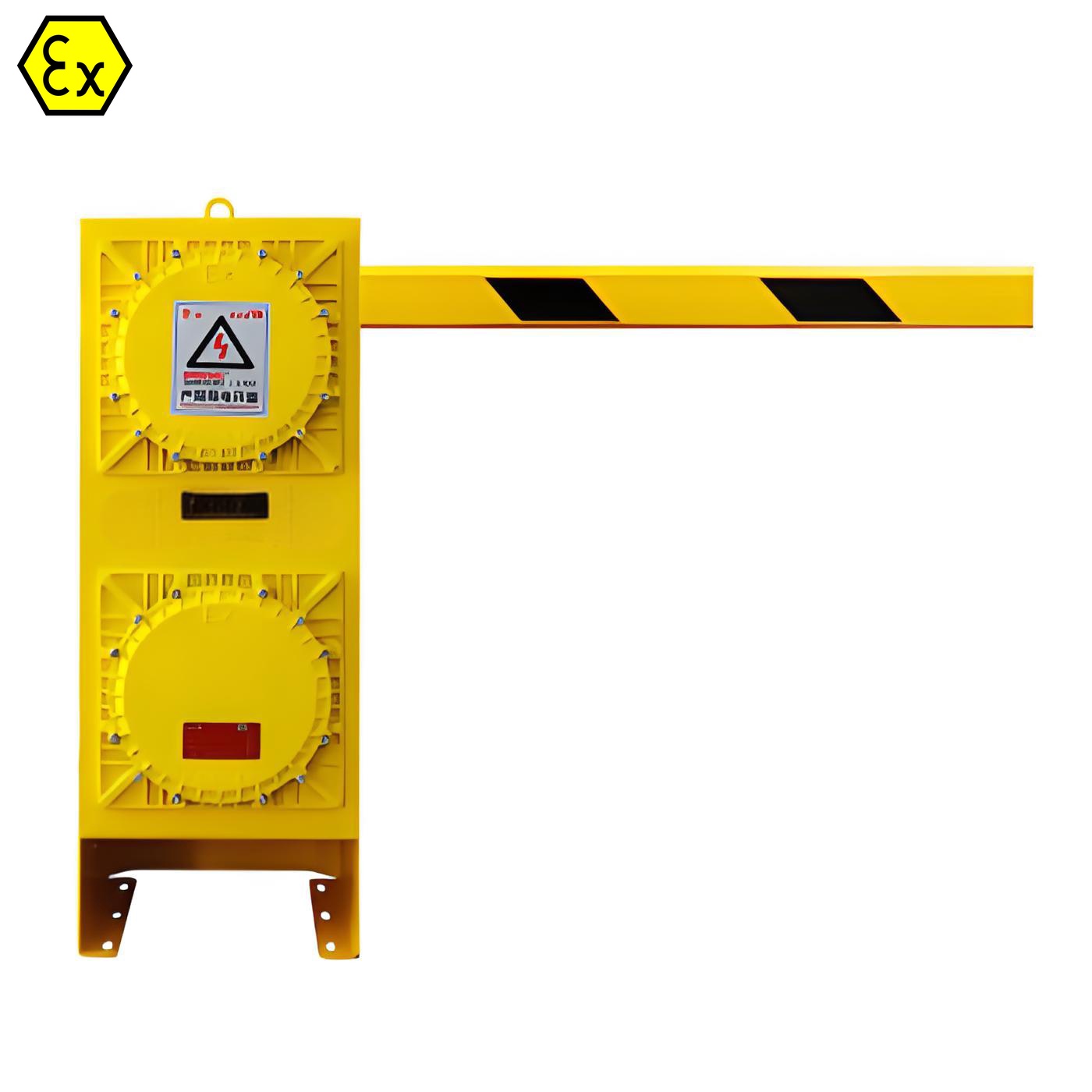
 Atex Certified Zone 1 & Zone 2, Zone 21 & 22 Explosion-proof Barrier Gate | Hazardous AreaThe EGDZ is an intelligent, fully integrated explosion-proof barrier gate built by CNWINNEX for explosive gas and combustible dust atmospheres. The cabinet, mechanism, motor and control unit are all designed as flameproof equipment, so the complete unit — not just the control box — is rated for hazardous areas. It controls vehicle and personnel access at plant gates, process unit entrances, tank farm inlets and product loading areas.
Its marking is dual. On the gas side, II 2 G Ex db IIC T4 Gb; on the dust side, II 2 D Ex tb IIIC T130°C Db; enclosure protection IP66. One unit therefore covers Zone 1 and Zone 2 areas with Group IIA, IIB or IIC gases at temperature classes T1 to T4, and also covers Zone 21 and Zone 22 dust areas — with no model change between a gas zone and a dust zone. CNWINNEX EGDZ-M Mini Explosion-Proof Barrier GateA Warning Sign Cannot Stop a Forklift
Your LNG cylinder yard sits right next to the plant road. A forklift takes the corner too tight, a truck pulls over to wait, a maintenance worker cuts through on foot. Three warning signs and two coats of floor marking later, the risk is still there. Access control in hazardous materials storage areas has always depended on the least reliable variable in any plant: human compliance.
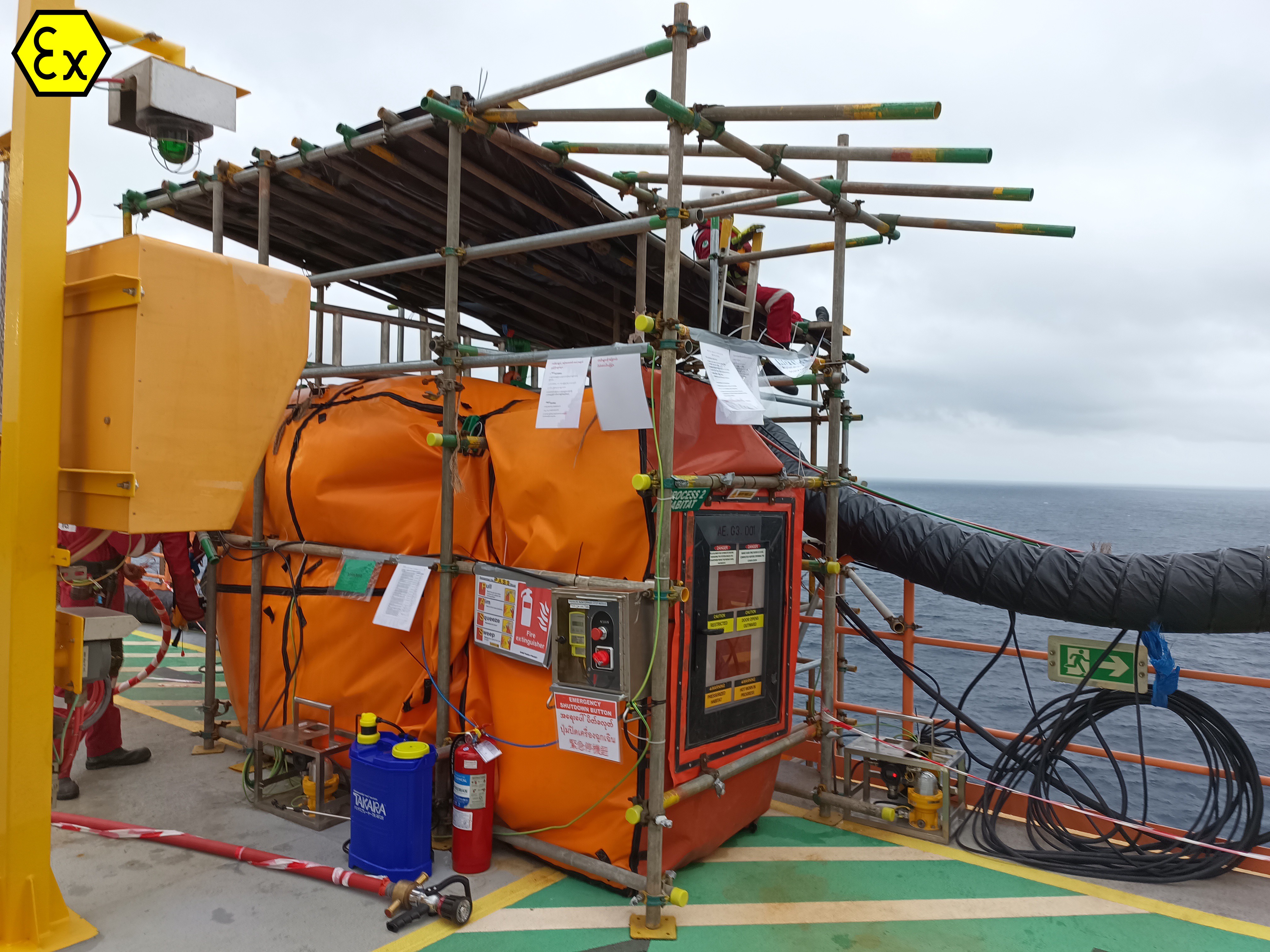
The real gap is not signage visibility. It is the absence of a physical boundary. The CNWINNEX EGDZ-M mini explosion-proof barrier gate closes that gap: a low-level boom placed across the storage-area entrance or fence gap, turning "no entry" from a painted slogan into a physical fact. CNWINNEX Pressurized Explosion-Proof Maintenance HabitatThe CNWINNEX Pressurized Explosion-proof Maintenance Habitat is a relocatable, positive-pressure explosion-proof working space built for on-site maintenance, hot work and equipment servicing in explosive hazardous areas. The main frame is assembled from industrial heavy-duty aluminium profiles, with flame-retardant shelter panels forming the surrounding walls. The habitat is of overall pressurized explosion-proof construction, with a separate access door and buffer room as well as an emergency escape door and observation windows. Outside the shelter, two sets of explosion-proof pressurized fresh-air blower systems connect to an external pressurized fresh-air source, creating a clean working environment that continuously maintains positive pressure inside the hazardous area.
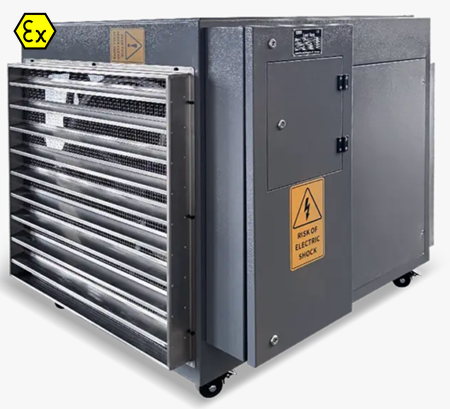
 200kW CNWINNEX Positive-Pressure (pxb) Explosion-Proof Resistive Load Bank · ATEX CertifiedThe CNWINNEX 200KW positive-pressure explosion-proof load bank is a canopy-type resistive load testing unit built around positive-pressure (pxb) explosion protection. Rated at 400Vac, 50Hz, three-phase four-wire (3P4W) with a power factor of 1.0, the unit achieves 1kW fine staging through 10 resistive load stages. Weighing only 220kg and fitted with 4 heavy-duty castors, it can be relocated and deployed flexibly in equipment rooms, workshops and outdoor sites, making it an ideal load verification tool for 200kW-class generator sets, UPS systems, energy storage systems and data centre equipment in hazardous areas.
- Pressurized Explosion-proof Resistive Load Bank 500KWThe CNWINNEX 500KW Pressurized explosion-proof load bank is a high-power resistive load testing unit designed specifically for explosive hazardous areas. Rated at 400Vac, 50Hz, three-phase four-wire (3P4W) with a power factor of 1.0, it delivers high-precision and repeatable on-load testing for generator sets, UPS systems, power grids and energy storage systems. Built with a containerized structure and side-discharge airflow design, and equipped with a Siemens SIMATIC S7-200 SMART PLC and HMI touch screen, the unit supports both local and remote (Modbus TCP) control modes, combining industrial-grade durability with flexible deployment.
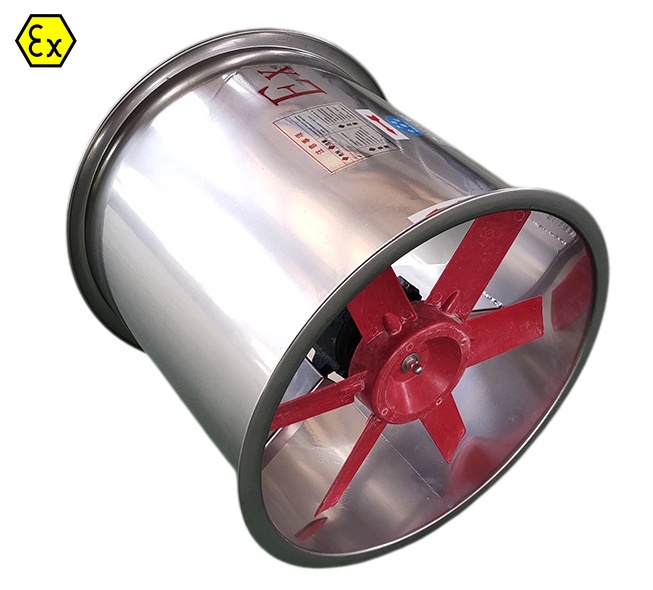
 CNWINNEX BT35-11-11.2 Explosion-Proof Stainless Steel Axial Fan: 67,892 m³/h High-Volume Airflow for Centralized Ventilation Power in Large Hazardous SpacesIn large refinery process areas, hazardous-material storage warehouses, and onshore terminals of offshore platforms, the central contradiction in ventilation systems is often not whether explosion-proof certification exists, but whether sufficient air volume can be moved through the hazardous area per unit of time. When spatial scale rises to thousands of square meters, ceiling heights exceed ten meters, or duct routes cross multiple fire compartments, the air-change rate that conventional small and medium fan sizes achieve only through multiple parallel units can be delivered by a single high-volume unit—reducing installation nodes, and with them, the explosion-proof interfaces and maintenance touchpoints at every node.
 CNWINNEX BT35-11-6.3 Explosion-Proof Stainless Steel Axial Fan: 18,250 m³/h Medium-High Airflow for Reliable Ventilation Boundaries in Corrosive Hazardous WorkshopsIn the routine ventilation design of chemical workshops, hazardous-material warehouses, and oil and gas stations, equipment selection often faces an implicit contradiction: explosion-proof compliance answers whether a fan can be used at all, but the corrosion degradation of impellers and casings in carbon steel or aluminum alloy units under humid, mildly corrosive, or sulfur-bearing atmospheres steadily erodes the boundary of how long it remains usable. A fan that runs safely in a Zone 1 area for three years may still require premature replacement because pitting on the blades throws off dynamic balance and reduces airflow—a problem that explosion-proof certification alone does not address, but that material and process engineering must answer.
The CNWINNEX BT35-11-6.3 Explosion-Proof Stainless Steel Axial Fan is designed for precisely this contradiction: stainless steel casing and impeller confront corrosive gases and humid environments, ATEX Directive 2014/34/EU and EN 60079 series CNWINNEX BT35-11-3.15 Explosion-Proof Stainless Steel Axial Fan: ATEX-Compliant High-Efficiency, Low-Noise VentilationIn the explosive hazardous areas of petrochemical plants, oil and gas stations, hazardous-material storage facilities, and offshore platforms, ventilation equipment is not merely a process accessory—it is a foundational line of defense for the working environment. Conventional fans often struggle to reconcile material durability with explosion-proof reliability when faced with high salt spray, corrosive gases, and explosive atmospheres. The CNWINNEX BT35-11-3.15 Explosion-Proof Stainless Steel Axial Fan is engineered precisely for the ventilation demands of Zone 1 and Zone 2 high-risk environments. The product addresses corrosion challenges through stainless steel construction, establishes its explosion-proof baseline on ATEX and EN 60079 series standards, and balances 3,076 m³/h airflow with low-noise operation within a compact frame.


Atex Certified Zone 1 & Zone 2, Zone 21 & 22 Explosion-proof Barrier Gate | Hazardous Area
The EGDZ is an intelligent, fully integrated explosion-proof barrier gate built by CNWINNEX for explosive gas and combustible dust atmospheres. The cabinet, mechanism, motor and control unit are all designed as flameproof equipment, so the complete unit — not just the control box — is rated for hazardous areas. It controls vehicle and personnel access at plant gates, process unit entrances, tank farm inlets and product loading areas.
Its marking is dual. On the gas side, II 2 G Ex db IIC T4 Gb; on the dust side, II 2 D Ex tb IIIC T130°C Db; enclosure protection IP66. One unit therefore covers Zone 1 and Zone 2 areas with Group IIA, IIB or IIC gases at temperature classes T1 to T4, and also covers Zone 21 and Zone 22 dust areas — with no model change between a gas zone and a dust zone.
Typical industries are petroleum, chemical, pharmaceutical, metallurgy, textile, natural gas and fire protection. In refineries, oil depots, chemical plant gatehouses, solvent workshops and underground factories, the EGDZ does one job: it turns "who is allowed in" from a warning sign into a physical barrier that actually stops a vehicle.
2. Why a Standard Barrier Gate Cannot Guard a Hazardous Area
It is common on retrofit projects to move an ordinary barrier gate to a hazardous area entrance and add an explosion-proof control box, on the assumption that this makes the installation compliant. It almost never passes inspection, and the reason is not build quality — it is that an ordinary barrier gate is itself an ignition source.
A standard barrier has at least three ignition paths: brush sparking in the motor during commutation, relay arcing inside the control box, and static charge built up on the housing and moving parts. Under normal conditions none of them matters. But when a process upset releases flammable gas, the barrier stands directly in the path of the dispersing cloud, and it becomes the first piece of equipment on site to ignite. That gate is usually also the only route people and vehicles have to get out.
Once this is clear, the selection criteria become obvious. What matters is not how fast the boom lifts or how good the paint looks, but which zone, gas group and temperature class the marking covers — and whether the complete unit holds a type certificate as a single piece of equipment.
The six features listed in our catalogue each answer a specific engineering question. They are set out below so that purchasing and technical teams can check them off one by one.
3.1 IIC Flameproof, Gas and Dust on One Certificate
● IIC is the highest gas group, covering hydrogen and acetylene — the gases with the lowest minimum ignition energy. Where the site only handles propane, ethylene or petroleum vapour (Group IIA / IIB), an IIC unit is over-specified, but that margin is not wasted: it removes the risk of a future process change or media change forcing a second barrier purchase.
● The dust side matters just as much. Ex tb IIIC covers conductive dust, and the 130°C surface limit means the housing must stay below the ignition temperature of the dust cloud and the dust layer. Many projects specify gas protection only, then discover at dust-zone commissioning that the gate cannot be accepted.
3.2 Integrated Mechatronics: Gear Drive and Arc Three-Link Crankshaft
The core transmission uses a gear drive with an arc-shaped three-link crankshaft. Three practical benefits follow: the speed curve through the lift is closer to a smooth transition, so impact at the end of travel is low and the cabinet and foundation stay tight far longer than with a pure linkage design.
The gear mesh also provides a large heat dissipation area, keeping motor temperature rise under control during frequent cycling, while noise stays low — a real improvement for gatehouses operating at night.
3.3 Carbon Steel Housing with Electrostatic Spray Coating
The cabinet is built from quality carbon steel and finished with high-voltage electrostatic spray coating, giving an even, dense film with good impact and corrosion resistance. Corrosion on chemical and coastal sites rarely starts in the steel plate itself — it starts at a coating breach and spreads from the rust point. A uniform coating is the single most direct way to extend service life. The standard colour is safety yellow, which also works as a visual warning at a plant entrance.
3.4 Custom Gears and a Dedicated Gearbox
Reduction ratio 1:50, driven by a 160 W brushless motor at 1400 r/min no-load speed. The custom gears deliver transmission efficiency; the dedicated barrier gearbox delivers smooth running. Together they are what keeps a 4 m boom free of judder and rattle when it completes a lift in 1.2 seconds. A brushless motor has no brushes, therefore no brush wear and no commutation spark — which is precisely what allows it to sit inside a flameproof enclosure.
3.5 1.2–3 s Adjustable Speed, Manual Release on Power Failure
Opening and closing time is adjustable between 1.2 and 3 seconds. Busy main gates run on the fast setting; heavy-duty or oversized-vehicle lanes run slower to reduce the risk of contact with the boom. On power failure the boom can be raised manually to release traffic, and the unit resets automatically when power returns — no manual re-calibration of the limit positions.
3.6 IP66 for All-Weather Duty
IP66 means dust-tight and protected against powerful water jets. Combined with a mechanism operating range of -30°C to +70°C, the unit runs outdoors year-round in sand-laden desert wind, southern China sun and rain, and coastal salt spray. Hazardous area gates rarely have the option of a canopy, so the ingress protection rating is the last line of defence.
The table below follows the published catalogue and the factory data sheet. For selection purposes, the nameplate and the approved project confirmation sheet take precedence; abnormal conditions such as extreme low temperature, aggressive corrosion or heavy dust loading must be assessed before ordering.
5. EGDZ or EGDZ-M: Choosing the Right Model
CNWINNEX offers two explosion-proof barrier ranges. The names are similar; the gates they guard are not. The most common specification error is fitting the mini model to a plant main gate, or forcing a 4 m boom unit into a two-metre-wide storage compound.
The test is simple: is there a queue of vehicles behind this gate? If yes, specify the EGDZ. If the requirement is that a defined area should not be entered freely, and both width and traffic are limited, specify the EGDZ-M. The two do not compete on one site — a typical layout uses the EGDZ at the main gate and the EGDZ-M at internal storage compounds.
An explosion-proof barrier is not a general security product; its value only exists at a specific process location. These five are where the EGDZ is most often installed.
6.1 Refinery Process Units and Product Loading Areas
Loading bays sit on the boundary between Zone 1 and Zone 2, and vehicles must enter one at a time under control. Here the 1.2-second lift is an efficiency question: a tanker may pass two or three gates between the site entrance and the loading position, and two seconds lost at each gate accumulates into a visible queue over a shift.
6.2 Oil and Gas Terminals and LNG Stations
Terminal gates and tank farm isolation gates are the classic installation point. These sites are highly sensitive to the question of release on power failure, which makes manual operation and automatic reset a hard requirement rather than a convenience.
6.3 Chemical and Fine Chemical Gatehouses
Fine chemical sites handle mixed media and frequently present both gas and dust hazards. The dual gas-and-dust marking lets one unit cover both, avoiding the confusion of managing two equipment variants at a single gatehouse.
6.4 Pharmaceutical Plants and Solvent Workshops
Pharmaceutical workshops use ethanol, acetone and similar solvents, which fall under Group IIB. IP66 and a dense surface finish both matter here: the integrity of the coating directly determines service life under frequent cleaning and disinfection.
6.5 Metallurgy, Textile and Underground Factories
What these sites share is high dust concentration and elevated ambient temperature. IP66 plus a -30°C to +70°C mechanism range keeps the unit stable both on the hot side of a metallurgical plant and in the damp environment of an underground factory.
7. Installation and Integration
● Half of an explosion-proof installation's reliability is decided at the factory, the other half on site. These four points account for most of the problems seen at handover.
● Foundation and level: the cabinet is floor mounted on a concrete base with cast-in anchors matched to the 350 × 300 mm footprint. The mounting face must be level; a cabinet that settles out of plumb loads the mechanism unevenly over time.
● Fixing direction: standard is left fixed when facing the gate, with the boom extending to the right. Right-fixed units must be specified on the order — reversing the direction on site disturbs the original assembly state of the flameproof joints.
● Electrical work: 240 V single-phase supply, cable entry through steel conduit or explosion-proof flexible conduit, housing reliably earthed. Cable routing, sealing glands and earth resistance must comply with the local explosion-proof installation code.
● System integration: beyond the standard wireless remote, the unit can be integrated with explosion-proof vehicle recognition, weighbridge systems and access controllers. Interface type and protocol are confirmed per project and are not part of the standard configuration.
These are the five questions asked most often at quotation stage, answered against the actual EGDZ configuration.
Q1: Can we simply add an explosion-proof control box to a standard barrier gate?
No. Explosion-proof certification applies to the complete unit — motor, mechanism, terminal chamber and control unit are all assessed. If only the control box is replaced, the motor remains a standard motor with the same sparking and hot surfaces, and the assembly holds no type certificate, so neither project acceptance nor insurance approval will pass.
Q2: Is a 4 m boom long enough, and can it be extended?
It is sufficient for a single lane of up to 3.5 m clear width; a two-way lane must be assessed against its actual width. Maximum boom length for the EGDZ is 4 m and the standard configuration is not extended. For wider openings, use two opposing units or a different gate type rather than lengthening the boom — exceeding the design length changes the load path and the limit positions of the mechanism.
Q3: How do vehicles get out during a power failure?
The boom is raised manually to release traffic, and the unit resets automatically when power is restored, with no re-calibration required. For fire lanes and emergency exits, we recommend writing the manual release procedure into the site emergency plan and training the gatehouse staff during commissioning.
Q4: Can it be used in Zone 21 and Zone 22 dust areas?
Yes — the dust marking is II 2 D Ex tb IIIC T130°C Db. Two conditions apply: 130°C is the maximum surface temperature and must stay below the ignition temperature of the dust cloud and layer present on site; and dust accumulation affects heat dissipation, so the mounting position should avoid areas where dust settles permanently.
Q5: Which documents are supplied, and what is the lead time?
Each unit ships with the explosion-proof certificate and type certificate copies, the operating manual and the nameplate data sheet; export orders add a packing list inside the plywood case. Lead time depends on quantity and destination — for batch or full-container orders, please reserve a production slot in advance.
9. Request a Selection Proposal
A barrier gate selection needs only five inputs. Complete the table below and our engineering team will return a proposal suitable for quotation and for drawing development, normally within one working day.
Leave A Reply
Please give us a message