

Categories List
Recent Posts
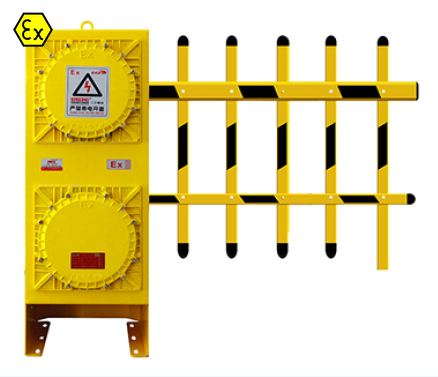
 Fence-Type Explosion-Proof Barrier Gate | ATEX Zone 1 | CNWINNEXThe EGDZ fence-type explosion-proof barrier gate is the variant in the CNWINNEX range built for sites where people and vehicles share one entrance. The cabinet, mechanism, motor and control unit are flameproof; the boom is a two-rail or three-rail fence section, so it stops vehicles and also stops anyone trying to duck under or climb over the arm.
It answers the hardest kind of hazardous-area entrance: staff walking through during the day, tankers entering at night, and no continuous wall on either side. A single straight boom at that location covers only half the risk. A fence section drops to form a continuous barrier roughly one metre high, and lifts as one piece, so vehicle speed is unaffected while the gaps for crawling and climbing are closed. Atex Certified Zone 1 & Zone 2, Zone 21 & 22 Explosion-proof Barrier Gate | Hazardous AreaThe EGDZ is an intelligent, fully integrated explosion-proof barrier gate built by CNWINNEX for explosive gas and combustible dust atmospheres. The cabinet, mechanism, motor and control unit are all designed as flameproof equipment, so the complete unit — not just the control box — is rated for hazardous areas. It controls vehicle and personnel access at plant gates, process unit entrances, tank farm inlets and product loading areas.
Its marking is dual. On the gas side, II 2 G Ex db IIC T4 Gb; on the dust side, II 2 D Ex tb IIIC T130°C Db; enclosure protection IP66. One unit therefore covers Zone 1 and Zone 2 areas with Group IIA, IIB or IIC gases at temperature classes T1 to T4, and also covers Zone 21 and Zone 22 dust areas — with no model change between a gas zone and a dust zone. CNWINNEX EGDZ-M Mini Explosion-Proof Barrier GateA Warning Sign Cannot Stop a Forklift
Your LNG cylinder yard sits right next to the plant road. A forklift takes the corner too tight, a truck pulls over to wait, a maintenance worker cuts through on foot. Three warning signs and two coats of floor marking later, the risk is still there. Access control in hazardous materials storage areas has always depended on the least reliable variable in any plant: human compliance.
The real gap is not signage visibility. It is the absence of a physical boundary. The CNWINNEX EGDZ-M mini explosion-proof barrier gate closes that gap: a low-level boom placed across the storage-area entrance or fence gap, turning "no entry" from a painted slogan into a physical fact. CNWINNEX Pressurized Explosion-Proof Maintenance HabitatThe CNWINNEX Pressurized Explosion-proof Maintenance Habitat is a relocatable, positive-pressure explosion-proof working space built for on-site maintenance, hot work and equipment servicing in explosive hazardous areas. The main frame is assembled from industrial heavy-duty aluminium profiles, with flame-retardant shelter panels forming the surrounding walls. The habitat is of overall pressurized explosion-proof construction, with a separate access door and buffer room as well as an emergency escape door and observation windows. Outside the shelter, two sets of explosion-proof pressurized fresh-air blower systems connect to an external pressurized fresh-air source, creating a clean working environment that continuously maintains positive pressure inside the hazardous area.
 200kW CNWINNEX Positive-Pressure (pxb) Explosion-Proof Resistive Load Bank · ATEX CertifiedThe CNWINNEX 200KW positive-pressure explosion-proof load bank is a canopy-type resistive load testing unit built around positive-pressure (pxb) explosion protection. Rated at 400Vac, 50Hz, three-phase four-wire (3P4W) with a power factor of 1.0, the unit achieves 1kW fine staging through 10 resistive load stages. Weighing only 220kg and fitted with 4 heavy-duty castors, it can be relocated and deployed flexibly in equipment rooms, workshops and outdoor sites, making it an ideal load verification tool for 200kW-class generator sets, UPS systems, energy storage systems and data centre equipment in hazardous areas.
- Pressurized Explosion-proof Resistive Load Bank 500KWThe CNWINNEX 500KW Pressurized explosion-proof load bank is a high-power resistive load testing unit designed specifically for explosive hazardous areas. Rated at 400Vac, 50Hz, three-phase four-wire (3P4W) with a power factor of 1.0, it delivers high-precision and repeatable on-load testing for generator sets, UPS systems, power grids and energy storage systems. Built with a containerized structure and side-discharge airflow design, and equipped with a Siemens SIMATIC S7-200 SMART PLC and HMI touch screen, the unit supports both local and remote (Modbus TCP) control modes, combining industrial-grade durability with flexible deployment.
 CNWINNEX BT35-11-11.2 Explosion-Proof Stainless Steel Axial Fan: 67,892 m³/h High-Volume Airflow for Centralized Ventilation Power in Large Hazardous SpacesIn large refinery process areas, hazardous-material storage warehouses, and onshore terminals of offshore platforms, the central contradiction in ventilation systems is often not whether explosion-proof certification exists, but whether sufficient air volume can be moved through the hazardous area per unit of time. When spatial scale rises to thousands of square meters, ceiling heights exceed ten meters, or duct routes cross multiple fire compartments, the air-change rate that conventional small and medium fan sizes achieve only through multiple parallel units can be delivered by a single high-volume unit—reducing installation nodes, and with them, the explosion-proof interfaces and maintenance touchpoints at every node.
 CNWINNEX BT35-11-6.3 Explosion-Proof Stainless Steel Axial Fan: 18,250 m³/h Medium-High Airflow for Reliable Ventilation Boundaries in Corrosive Hazardous WorkshopsIn the routine ventilation design of chemical workshops, hazardous-material warehouses, and oil and gas stations, equipment selection often faces an implicit contradiction: explosion-proof compliance answers whether a fan can be used at all, but the corrosion degradation of impellers and casings in carbon steel or aluminum alloy units under humid, mildly corrosive, or sulfur-bearing atmospheres steadily erodes the boundary of how long it remains usable. A fan that runs safely in a Zone 1 area for three years may still require premature replacement because pitting on the blades throws off dynamic balance and reduces airflow—a problem that explosion-proof certification alone does not address, but that material and process engineering must answer.
The CNWINNEX BT35-11-6.3 Explosion-Proof Stainless Steel Axial Fan is designed for precisely this contradiction: stainless steel casing and impeller confront corrosive gases and humid environments, ATEX Directive 2014/34/EU and EN 60079 series


Fence-Type Explosion-Proof Barrier Gate | ATEX Zone 1 | CNWINNEX
The EGDZ fence-type explosion-proof barrier gate is the variant in the CNWINNEX range built for sites where people and vehicles share one entrance. The cabinet, mechanism, motor and control unit are flameproof; the boom is a two-rail or three-rail fence section, so it stops vehicles and also stops anyone trying to duck under or climb over the arm.
It answers the hardest kind of hazardous-area entrance: staff walking through during the day, tankers entering at night, and no continuous wall on either side. A single straight boom at that location covers only half the risk. A fence section drops to form a continuous barrier roughly one metre high, and lifts as one piece, so vehicle speed is unaffected while the gaps for crawling and climbing are closed.
The scope of use matches the rest of the EGDZ range: petroleum, chemical, pharmaceutical, metallurgy, textile, natural gas and fire protection, in Zone 1 and Zone 2 gas atmospheres of Group IIA, IIB or IIC, and in Zone 21 and Zone 22 dust areas.
2. A Straight Boom Stops Vehicles, Not People
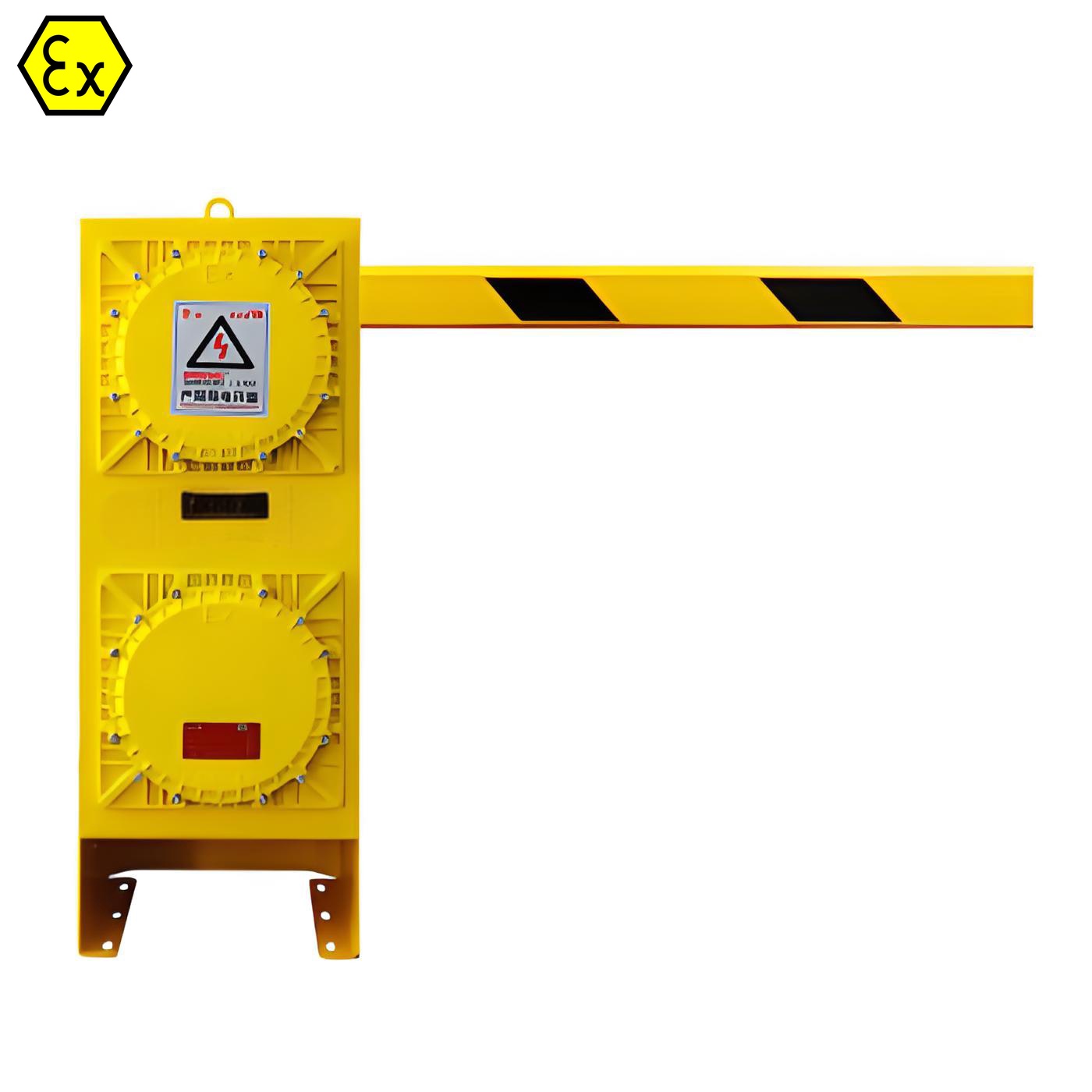
Nearly every explosion-proof barrier is specified with a straight boom by default, for good reasons: simple structure, fast operation, clear sight lines, lower cost. But there is a physical fact that gets overlooked — the underside of the arm usually sits about one metre above the ground, and an adult can walk under it with a slight duck of the head.
On an ordinary industrial site that hardly matters, because someone is standing at the gate. On a hazardous-area site the gatehouse is often unmanned with remote authorisation, or staffed by one guard watching several screens at night. In that configuration the straight boom protects against vehicles only; pedestrian access depends entirely on people choosing to comply.
The fence variant closes exactly that gap. Two or three horizontal rails divide the metre of clearance into shallow cells that cannot be crawled through or climbed over, and once lowered they form a continuous barrier. No extra electronics, no change to the control logic — it simply completes the physical part of the job.
Converting a straight boom into a fence section is not a matter of bolting on a mesh panel. Self-weight, wind area and rotational inertia all change, and the mechanism and counterbalance have to change with them — otherwise the arm sags, judders and drifts off its limits within a season.
3.1 Two Rails or Three: Two Densities of Protection
The two-rail section uses upper and lower rails with vertical spacers, giving wider cells, better sight lines and lower wind load — suitable for main gates and the outer side of loading racks where staff need to see in. It can reach 4.5 m. The three-rail section adds a middle rail, closes the cells and resists crawling more effectively; boom length is kept to 3.5–4 m, which suits cylinder yards and hazardous goods holding areas where the requirement is to block, not to see through.
3.2 Three Seconds or Six: Speed Follows Boom Length
A fence section carries its mass very differently from a straight arm, so the 1.2-second timing of a short straight boom does not transfer. The published steps are: two-rail 3–4 m at 3 s, two-rail 4–4.5 m at 6 s, three-rail 3.5–4 m at 6 s. This is inertia matching, not a compromise in performance — the heavier and longer the arm, the more travel is needed to absorb the stop, otherwise every cycle ends in an impact that consumes mechanism life.
3.3 A Shared Cabinet Platform
The fence and straight variants share the 350 × 970 × 300 mm cabinet and mechanism, differing only in boom assembly and counterbalance. The practical benefit for an owner is spare-part commonality: on a site with a straight boom at the main gate and fence sections at the compound, the gearbox, motor and control board are one inventory item instead of two.
3.4 Joints and Limits: Where Fence Reliability Lives
Fence failures almost always occur at the connections — a slack bar clamp that skews the whole section, play in a joint that shows up as judder, limit drift that leaves the arm resting unevenly. The EGDZ uses a properly engineered bar clamp together with custom gears and a dedicated gearbox, holding these clearances within assembly tolerance so the rails stay level after landing and stay level over time.
4. Technical Specifications
The table gives the fence configuration; cabinet and electrical data are common with the straight variant. The nameplate and the approved project sheet take precedence. Certification scope and ingress protection can differ between bar types and electrical configurations, so confirm with engineering before ordering.
Table 1 EGDZ fence-type barrier gate specifications
5. Choosing Between Four Bar Types
The EGDZ range offers straight, 90° curved, 180° folding and fence arms. The difference is not premium versus basic; it is whether the site gives you a straight run, and whether people need to be stopped as well as vehicles.
Table 2 Where each bar type applies
A practical sequence: first ask whether the lane behind the gate carries main traffic (if so, straight or long boom); then whether anyone walks through at night (if so, fence); then whether the site allows a straight run (if not, curved or folding). Three questions usually settle the bar type.
6. Typical Applications
A fence gate earns its cost only where people and vehicles share one opening. These five locations are where it is most often installed.
● Perimeter gaps at hazardous goods compounds: where the wall is discontinuous and the barrier stands in for a wall section.
● Cylinder yards and temporary chemical stores: small area, rare traffic, absolutely no unauthorised entry — a three-rail section fits.
● Outer side of loading racks: daytime pedestrian movement is frequent; a two-rail section blocks people without blocking the view of operations.
● Substation and process unit side gates: secondary routes with poor lighting and thin staffing, where physical closure beats electronic authorisation.
● Mixed-traffic gatehouses: sites without a separate pedestrian gate, where the fence section closes the pedestrian side instead of adding a new door.
7. FAQ
Four questions that come up most often at quotation stage for fence-type units.
Q1: Can a fence section span 6 m?
Not recommended. Maximum boom length is 4.5 m for two-rail and 4 m for three-rail. Beyond that, self-weight and wind area push rotational inertia outside the mechanism's design envelope, producing sag and judder at the tip. For a 6 m opening, use a straight boom or two opposing units.
Q2: Will wind deform the fence?
A fence section presents noticeably more wind area than a straight arm, which is one reason its operating time is longer. For coastal or exposed sites, provide the local basic wind pressure at design stage so engineering can confirm whether the section needs reinforcement or a shorter span.
Q3: Why does the fence take 6 seconds when a straight boom takes 1.2?
Because it is heavier. The mass of a fence section sits further from the pivot, so inertia is higher and the travel needs a longer cushion — otherwise every arrival is a hard impact. The six seconds buy long-term stability of both mechanism and arm, which is entirely adequate for a compound perimeter with low traffic.
Q4: Can it integrate with vehicle recognition or access control?
Yes. Beyond the standard wireless remote, dry-contact interfaces can be reserved for explosion-proof vehicle recognition, access controllers or weighbridge systems. Interface type and protocol are confirmed per project and are not supplied as standard.
8. Request a Selection Proposal
Four inputs are enough to specify a fence gate. Send them across and our engineering team will come back with a bar-type recommendation and pricing, normally within one working day.
Leave A Reply
Please give us a message