

Categories List
Recent Posts
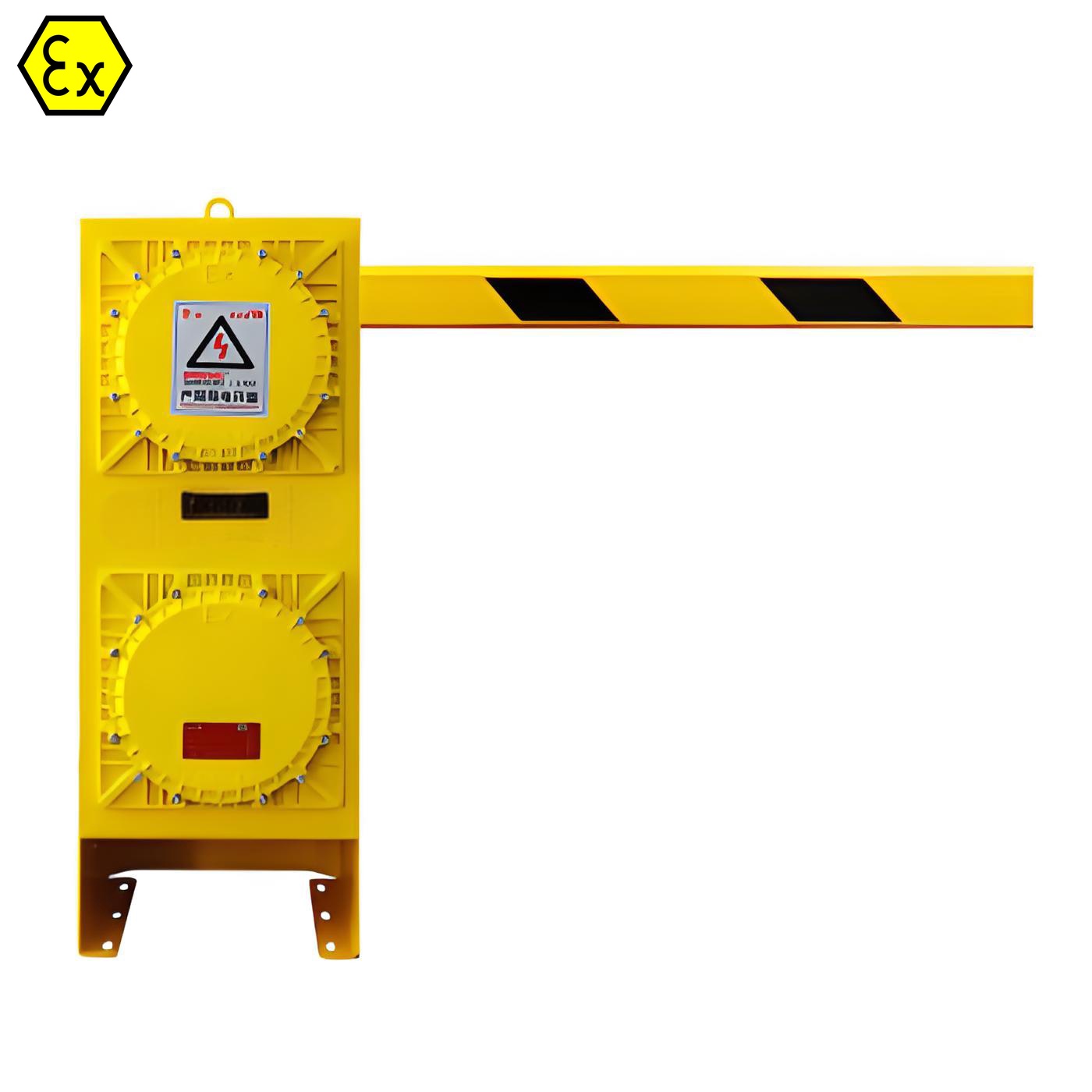
 6m Long-Boom Explosion-Proof Barrier Gate | ATEX Zone 1 | CNWINNEXThe EGDZ long-boom explosion-proof barrier gate is the widest-opening configuration in the CNWINNEX range: a single arm up to 6 m, spanning a two-way lane and replacing the conventional pair of opposing units. Cabinet, mechanism, motor and control unit are flameproof, rated for Zone 1 and Zone 2 areas with Group IIA, IIB or IIC gases.
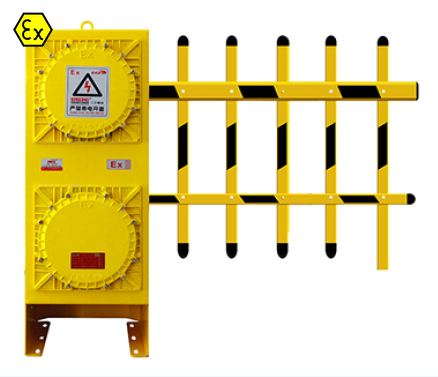
The engineering difficulty is not making the arm long; it is keeping a long arm stable. Double the length and rotational inertia rises with the square, so tip deflection, swing during travel and impact at the end stop all scale up. The same 160 W brushless motor driving a 3 m arm and a 6 m arm represents two different design problems. Fence-Type Explosion-Proof Barrier Gate | ATEX Zone 1 | CNWINNEXThe EGDZ fence-type explosion-proof barrier gate is the variant in the CNWINNEX range built for sites where people and vehicles share one entrance. The cabinet, mechanism, motor and control unit are flameproof; the boom is a two-rail or three-rail fence section, so it stops vehicles and also stops anyone trying to duck under or climb over the arm.
It answers the hardest kind of hazardous-area entrance: staff walking through during the day, tankers entering at night, and no continuous wall on either side. A single straight boom at that location covers only half the risk. A fence section drops to form a continuous barrier roughly one metre high, and lifts as one piece, so vehicle speed is unaffected while the gaps for crawling and climbing are closed.- Atex Certified Zone 1 & Zone 2, Zone 21 & 22 Explosion-proof Barrier Gate | Hazardous AreaThe EGDZ is an intelligent, fully integrated explosion-proof barrier gate built by CNWINNEX for explosive gas and combustible dust atmospheres. The cabinet, mechanism, motor and control unit are all designed as flameproof equipment, so the complete unit — not just the control box — is rated for hazardous areas. It controls vehicle and personnel access at plant gates, process unit entrances, tank farm inlets and product loading areas.
Its marking is dual. On the gas side, II 2 G Ex db IIC T4 Gb; on the dust side, II 2 D Ex tb IIIC T130°C Db; enclosure protection IP66. One unit therefore covers Zone 1 and Zone 2 areas with Group IIA, IIB or IIC gases at temperature classes T1 to T4, and also covers Zone 21 and Zone 22 dust areas — with no model change between a gas zone and a dust zone.  CNWINNEX EGDZ-M Mini Explosion-Proof Barrier GateA Warning Sign Cannot Stop a Forklift
Your LNG cylinder yard sits right next to the plant road. A forklift takes the corner too tight, a truck pulls over to wait, a maintenance worker cuts through on foot. Three warning signs and two coats of floor marking later, the risk is still there. Access control in hazardous materials storage areas has always depended on the least reliable variable in any plant: human compliance.
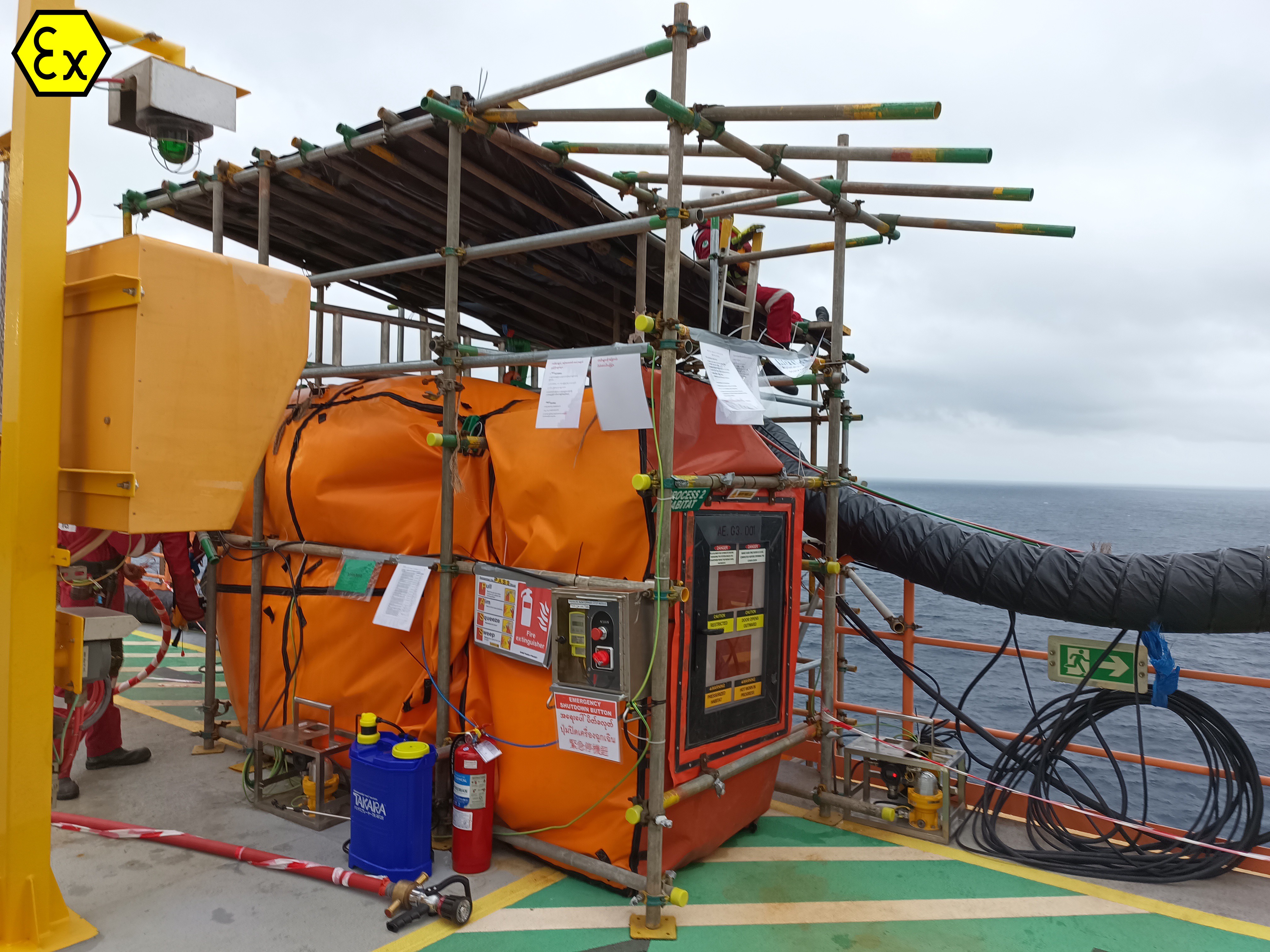
The real gap is not signage visibility. It is the absence of a physical boundary. The CNWINNEX EGDZ-M mini explosion-proof barrier gate closes that gap: a low-level boom placed across the storage-area entrance or fence gap, turning "no entry" from a painted slogan into a physical fact. CNWINNEX Pressurized Explosion-Proof Maintenance HabitatThe CNWINNEX Pressurized Explosion-proof Maintenance Habitat is a relocatable, positive-pressure explosion-proof working space built for on-site maintenance, hot work and equipment servicing in explosive hazardous areas. The main frame is assembled from industrial heavy-duty aluminium profiles, with flame-retardant shelter panels forming the surrounding walls. The habitat is of overall pressurized explosion-proof construction, with a separate access door and buffer room as well as an emergency escape door and observation windows. Outside the shelter, two sets of explosion-proof pressurized fresh-air blower systems connect to an external pressurized fresh-air source, creating a clean working environment that continuously maintains positive pressure inside the hazardous area.
 200kW CNWINNEX Positive-Pressure (pxb) Explosion-Proof Resistive Load Bank · ATEX CertifiedThe CNWINNEX 200KW positive-pressure explosion-proof load bank is a canopy-type resistive load testing unit built around positive-pressure (pxb) explosion protection. Rated at 400Vac, 50Hz, three-phase four-wire (3P4W) with a power factor of 1.0, the unit achieves 1kW fine staging through 10 resistive load stages. Weighing only 220kg and fitted with 4 heavy-duty castors, it can be relocated and deployed flexibly in equipment rooms, workshops and outdoor sites, making it an ideal load verification tool for 200kW-class generator sets, UPS systems, energy storage systems and data centre equipment in hazardous areas.
- Pressurized Explosion-proof Resistive Load Bank 500KWThe CNWINNEX 500KW Pressurized explosion-proof load bank is a high-power resistive load testing unit designed specifically for explosive hazardous areas. Rated at 400Vac, 50Hz, three-phase four-wire (3P4W) with a power factor of 1.0, it delivers high-precision and repeatable on-load testing for generator sets, UPS systems, power grids and energy storage systems. Built with a containerized structure and side-discharge airflow design, and equipped with a Siemens SIMATIC S7-200 SMART PLC and HMI touch screen, the unit supports both local and remote (Modbus TCP) control modes, combining industrial-grade durability with flexible deployment.
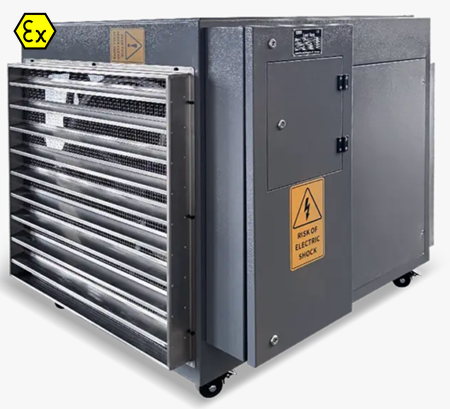
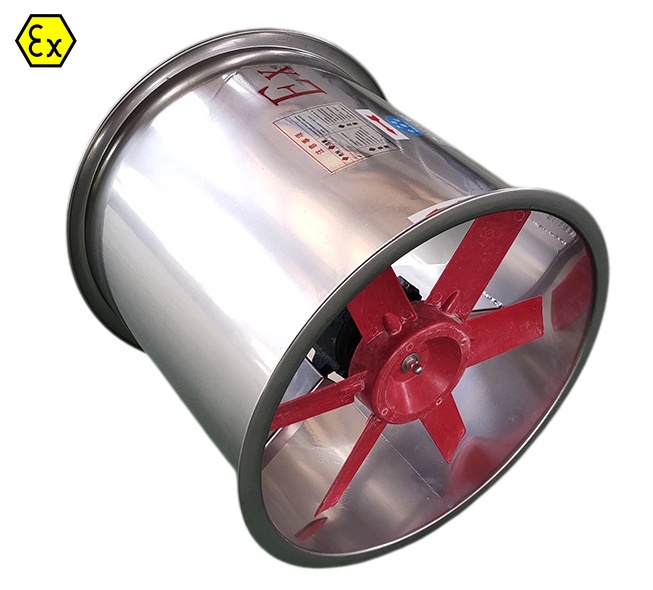
 CNWINNEX BT35-11-11.2 Explosion-Proof Stainless Steel Axial Fan: 67,892 m³/h High-Volume Airflow for Centralized Ventilation Power in Large Hazardous SpacesIn large refinery process areas, hazardous-material storage warehouses, and onshore terminals of offshore platforms, the central contradiction in ventilation systems is often not whether explosion-proof certification exists, but whether sufficient air volume can be moved through the hazardous area per unit of time. When spatial scale rises to thousands of square meters, ceiling heights exceed ten meters, or duct routes cross multiple fire compartments, the air-change rate that conventional small and medium fan sizes achieve only through multiple parallel units can be delivered by a single high-volume unit—reducing installation nodes, and with them, the explosion-proof interfaces and maintenance touchpoints at every node.


6m Long-Boom Explosion-Proof Barrier Gate | ATEX Zone 1 | CNWINNEX
The EGDZ long-boom explosion-proof barrier gate is the widest-opening configuration in the CNWINNEX range: a single arm up to 6 m, spanning a two-way lane and replacing the conventional pair of opposing units. Cabinet, mechanism, motor and control unit are flameproof, rated for Zone 1 and Zone 2 areas with Group IIA, IIB or IIC gases.
The engineering difficulty is not making the arm long; it is keeping a long arm stable. Double the length and rotational inertia rises with the square, so tip deflection, swing during travel and impact at the end stop all scale up. The same 160 W brushless motor driving a 3 m arm and a 6 m arm represents two different design problems.
Typical locations are refinery loading racks, oil depot loading areas, port tank farms, heavy-truck gatehouses and two-way site roads — all places where the lane is wide, the vehicles are large, traffic is constant, and narrowing the opening to suit a standard boom is not an option.
2. What a 6 m Boom Really Saves
The obvious solution for a wide lane is two opposing units meeting in the middle. That is common on ordinary industrial sites, but in a hazardous area its hidden cost is far higher than the equipment itself.
Every explosion-proof barrier needs its own flameproof terminal box, its own supply run and flexible conduit, its own foundation, and its own circuit in the control cabinet. Two units therefore mean two explosion-proof installations, two sets of wiring inspection records, two failure points, and an acceptance check performed twice. Where explosion-proof labour is a large share of project cost, this usually exceeds the equipment price difference.
A single 6 m unit consolidates all of it: one foundation, one supply route, one control circuit, one position to inspect. The price is a heavier arm and a more demanding mechanism — which is exactly why the long-boom variant exists.
3. Four Mechanical Constraints
Everything that separates a long-boom unit from a standard one comes down to four mechanical issues. Unresolved, the arm starts to sag within three months of installation.
3.1 Rotational Inertia: Ratio Moves from 1:50 to 1:150
The standard unit runs a 1:50 ratio with a 3 to 4.5 m arm. Push the arm to 6 m and both mass and moment arm increase, so the motor needs a higher reduction ratio to deliver torque while keeping travel speed inside a safe range. The long-boom configuration uses 1:150, roughly tripling output torque at the cost of speed — a trade that is clearly worth making on a wide lane.
3.2 Tip Deflection: Counterbalance Matched to Length
The self-weight bending of a 6 m arm is visible to the eye. The counterbalance spring exists to cancel that weight so the arm stays close to straight in the horizontal position. Preload must match the actual length: too tight and the lift is laboured and the motor overloads; too loose and the tip droops and lands unevenly. It is set at the factory for the ordered length and must not be adjusted on site.
3.3 Impact at the Stop: Speed Must Step Down
Tip speed equals angular speed times arm length. For the same 90° travel in 3 seconds, a 3 m arm moves its tip at half the speed of a 6 m arm. Run a 6 m arm on a 3-second cycle and the arrival impact goes straight into the mechanism and foundation, showing up later as limit drift, a loosened cabinet and faster gear wear. Long arms therefore step down to 4 or 5 seconds.
3.4 Heat and Continuous Duty: Brushless Motor with Gear Drive
Main-lane traffic is continuous and bunched; several hundred cycles a day is normal. A 160 W brushless motor has no brush wear, and the gear mesh itself is a good heat path, so temperature rise stays controllable at high cycle counts together with the flameproof housing's thermal design. This matters most on hot southern sites in summer.
4. Boom Length and Operating Time
The most common specification error on long booms is fixing the length and then choosing a speed at random. In the EGDZ range, length, operating time and reduction ratio are a matched set and should not be recombined freely.
Table 1 Boom length versus operating time
A pattern is visible: each step up in length costs one step in speed. That is not a performance compromise but the means of keeping tip impact within what the mechanism can absorb. If a supplier offers a 6 m arm at 1.2 seconds, ask for measured tip deflection and limit repeatability.
5. One 6 m Unit or Two Opposing Units
Both approaches work; the choice depends on clear width, traffic management and cost structure.
Table 2 Single long boom versus two opposing units
A simple rule: up to 6 m clear width with mainly two-way single-lane traffic, take the single long boom; above 6 m, or where both sides must open together for throughput, use two units. Exposed and typhoon-prone sites are a separate case — sail area is the long boom's one real weakness.
6. Typical Applications
The long boom earns its place where the lane is wide, the vehicles are large and the traffic is constant.
● Refinery loading racks: tankers enter one at a time; the lane cannot be narrowed, and a 6 m arm covers both directions at once.
● Oil depot loading areas: bunched in-and-out traffic, with the highest demands on motor and gear durability.
● Port and tank farm truck gates: large turning radii mean the arm must cover the full vehicle width with margin.
● Weighbridge approaches: one arm per weighing lane, interlocked with the scale for one-weigh, one-release operation.
● Two-way site roads: no central island, so one long unit replaces two and removes an obstruction from the roadway.
Four questions that recur at quotation stage for long-boom configurations.
Q1: Can the arm go beyond 6 m?
No. Six metres is the design limit of the EGDZ straight range. Beyond it, tip deflection and wind bending moment exceed the safe envelope for both arm and mechanism; a unit built anyway will show droop and limit drift within six months. Wider openings should use two opposing units.
Q2: Is a 6 m arm suitable in typhoon areas?
It needs checking. The large sail area means the local basic wind pressure should be provided at design stage so engineering can decide whether to shorten the arm or reinforce it. Where a long arm is confirmed, add a rule to the operating procedure to park the arm raised during high-wind warnings.
Q3: What if the arm is struck and broken?
The arm is a separate assembly and can be replaced without changing the whole unit. When replacing, inspect the bar clamp, spring and limit positions at the same time, because an impact usually leaves hidden deformation there first. Keeping one spare arm of the same length is worthwhile on larger sites.
Q4: How does weighbridge interlocking work?
The scale indicator or weighing software outputs a dry contact to the barrier controller, giving a weigh-release-lower sequence. Signal cabling inside the hazardous area must also follow explosion-proof installation practice; the exact interface is confirmed at design stage.
8. Request a Selection Proposal
Four inputs specify a long-boom gate. Send them across and engineering will return a length recommendation, speed step and pricing, normally within one working day.
Leave A Reply
Please give us a message