

Categories List
Recent Posts
 90° Curved & 180° Folding Explosion-Proof Barrier Gate | CNWINNEXThe EGDZ curved and folding arm explosion-proof barrier gate solves one problem: there is no clear straight run beside the lane. The 90° curved arm stands up along a wall or a piece of equipment once raised; the 180° folding arm doubles back on itself. Both control access where a straight boom cannot physically be installed. Cabinet, mechanism, motor and control unit are flameproof, rated for Zone 1 and Zone 2 areas with Group IIA, IIB or IIC gases.
These are not edge-case specials. Retrofits, process-unit densification, underground factories and jetty decks all share the same condition: the space is already occupied by equipment. The post position is fixed, the pipe rack height is fixed, the available clearance is fixed. Changing the site means shutdown, civil works and re-approval; changing the bar type means changing one drawing. 6m Long-Boom Explosion-Proof Barrier Gate | ATEX Zone 1 | CNWINNEXThe EGDZ long-boom explosion-proof barrier gate is the widest-opening configuration in the CNWINNEX range: a single arm up to 6 m, spanning a two-way lane and replacing the conventional pair of opposing units. Cabinet, mechanism, motor and control unit are flameproof, rated for Zone 1 and Zone 2 areas with Group IIA, IIB or IIC gases.
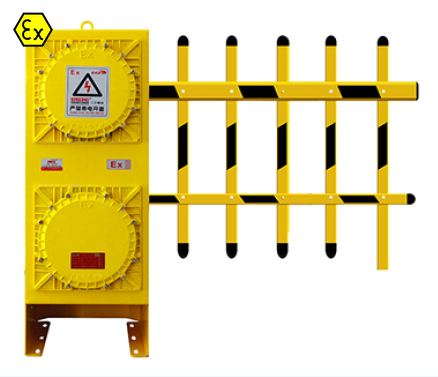
The engineering difficulty is not making the arm long; it is keeping a long arm stable. Double the length and rotational inertia rises with the square, so tip deflection, swing during travel and impact at the end stop all scale up. The same 160 W brushless motor driving a 3 m arm and a 6 m arm represents two different design problems.- Fence-Type Explosion-Proof Barrier Gate | ATEX Zone 1 | CNWINNEXThe EGDZ fence-type explosion-proof barrier gate is the variant in the CNWINNEX range built for sites where people and vehicles share one entrance. The cabinet, mechanism, motor and control unit are flameproof; the boom is a two-rail or three-rail fence section, so it stops vehicles and also stops anyone trying to duck under or climb over the arm.
It answers the hardest kind of hazardous-area entrance: staff walking through during the day, tankers entering at night, and no continuous wall on either side. A single straight boom at that location covers only half the risk. A fence section drops to form a continuous barrier roughly one metre high, and lifts as one piece, so vehicle speed is unaffected while the gaps for crawling and climbing are closed. - Atex Certified Zone 1 & Zone 2, Zone 21 & 22 Explosion-proof Barrier Gate | Hazardous AreaThe EGDZ is an intelligent, fully integrated explosion-proof barrier gate built by CNWINNEX for explosive gas and combustible dust atmospheres. The cabinet, mechanism, motor and control unit are all designed as flameproof equipment, so the complete unit — not just the control box — is rated for hazardous areas. It controls vehicle and personnel access at plant gates, process unit entrances, tank farm inlets and product loading areas.
Its marking is dual. On the gas side, II 2 G Ex db IIC T4 Gb; on the dust side, II 2 D Ex tb IIIC T130°C Db; enclosure protection IP66. One unit therefore covers Zone 1 and Zone 2 areas with Group IIA, IIB or IIC gases at temperature classes T1 to T4, and also covers Zone 21 and Zone 22 dust areas — with no model change between a gas zone and a dust zone.  CNWINNEX EGDZ-M Mini Explosion-Proof Barrier GateA Warning Sign Cannot Stop a Forklift
Your LNG cylinder yard sits right next to the plant road. A forklift takes the corner too tight, a truck pulls over to wait, a maintenance worker cuts through on foot. Three warning signs and two coats of floor marking later, the risk is still there. Access control in hazardous materials storage areas has always depended on the least reliable variable in any plant: human compliance.
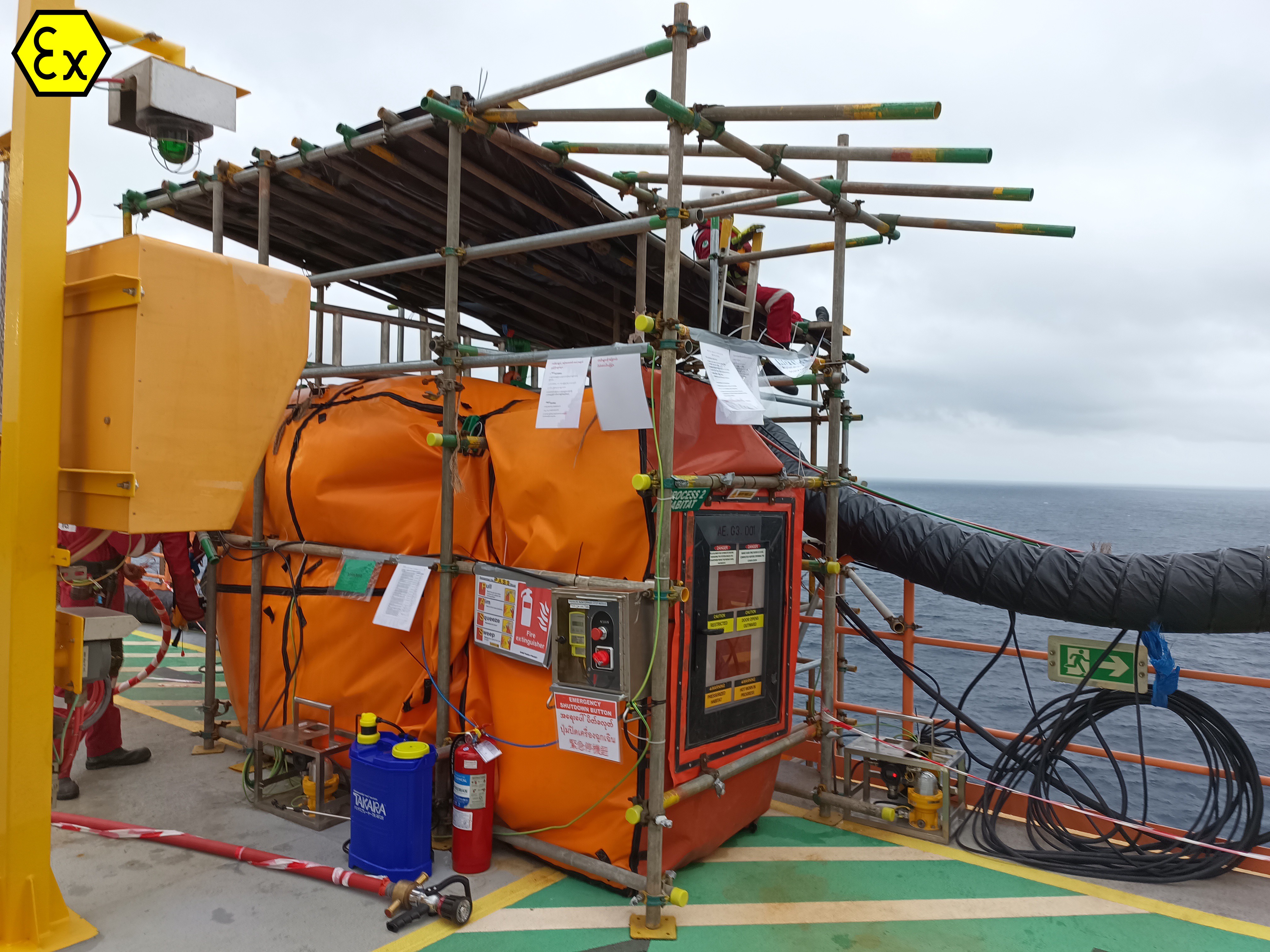
The real gap is not signage visibility. It is the absence of a physical boundary. The CNWINNEX EGDZ-M mini explosion-proof barrier gate closes that gap: a low-level boom placed across the storage-area entrance or fence gap, turning "no entry" from a painted slogan into a physical fact. CNWINNEX Pressurized Explosion-Proof Maintenance HabitatThe CNWINNEX Pressurized Explosion-proof Maintenance Habitat is a relocatable, positive-pressure explosion-proof working space built for on-site maintenance, hot work and equipment servicing in explosive hazardous areas. The main frame is assembled from industrial heavy-duty aluminium profiles, with flame-retardant shelter panels forming the surrounding walls. The habitat is of overall pressurized explosion-proof construction, with a separate access door and buffer room as well as an emergency escape door and observation windows. Outside the shelter, two sets of explosion-proof pressurized fresh-air blower systems connect to an external pressurized fresh-air source, creating a clean working environment that continuously maintains positive pressure inside the hazardous area.
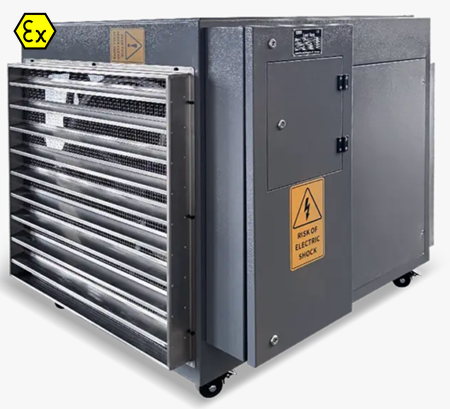
 200kW CNWINNEX Positive-Pressure (pxb) Explosion-Proof Resistive Load Bank · ATEX CertifiedThe CNWINNEX 200KW positive-pressure explosion-proof load bank is a canopy-type resistive load testing unit built around positive-pressure (pxb) explosion protection. Rated at 400Vac, 50Hz, three-phase four-wire (3P4W) with a power factor of 1.0, the unit achieves 1kW fine staging through 10 resistive load stages. Weighing only 220kg and fitted with 4 heavy-duty castors, it can be relocated and deployed flexibly in equipment rooms, workshops and outdoor sites, making it an ideal load verification tool for 200kW-class generator sets, UPS systems, energy storage systems and data centre equipment in hazardous areas.
- Pressurized Explosion-proof Resistive Load Bank 500KWThe CNWINNEX 500KW Pressurized explosion-proof load bank is a high-power resistive load testing unit designed specifically for explosive hazardous areas. Rated at 400Vac, 50Hz, three-phase four-wire (3P4W) with a power factor of 1.0, it delivers high-precision and repeatable on-load testing for generator sets, UPS systems, power grids and energy storage systems. Built with a containerized structure and side-discharge airflow design, and equipped with a Siemens SIMATIC S7-200 SMART PLC and HMI touch screen, the unit supports both local and remote (Modbus TCP) control modes, combining industrial-grade durability with flexible deployment.


90° Curved & 180° Folding Explosion-Proof Barrier Gate | CNWINNEX
1. Product Overview
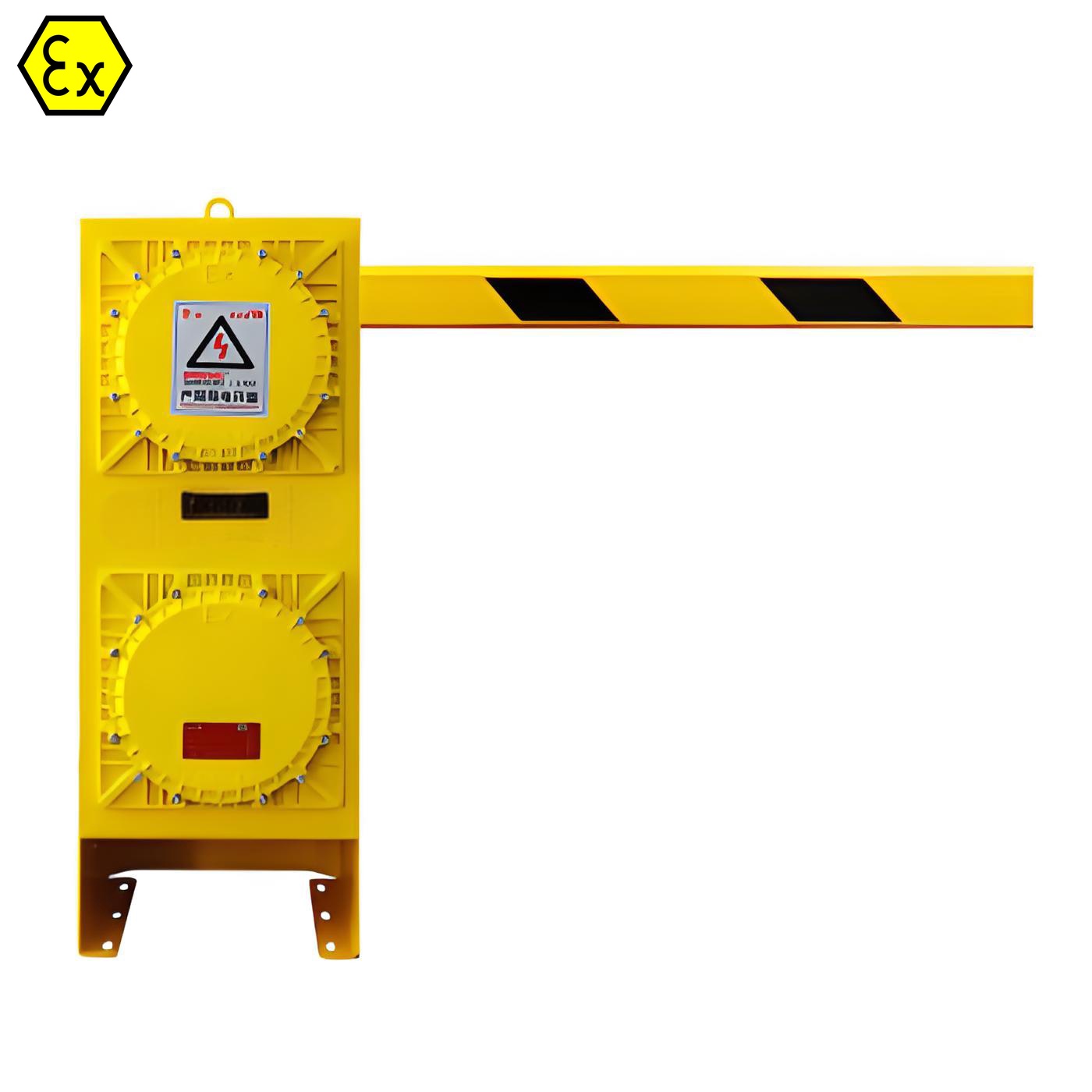
The EGDZ curved and folding arm explosion-proof barrier gate solves one problem: there is no clear straight run beside the lane. The 90° curved arm stands up along a wall or a piece of equipment once raised; the 180° folding arm doubles back on itself. Both control access where a straight boom cannot physically be installed. Cabinet, mechanism, motor and control unit are flameproof, rated for Zone 1 and Zone 2 areas with Group IIA, IIB or IIC gases.
These are not edge-case specials. Retrofits, process-unit densification, underground factories and jetty decks all share the same condition: the space is already occupied by equipment. The post position is fixed, the pipe rack height is fixed, the available clearance is fixed. Changing the site means shutdown, civil works and re-approval; changing the bar type means changing one drawing.
These units usually serve the second or third gate rather than the main entrance: process unit side doors, passages under pipe racks, underground ramp entries, substation side gates. Traffic is light, but a failure there is no less serious than at the main gate.
2. When the Site Gives You No Straight Line
A straight boom assumes clear space above it: unbroken, unobstructed, and at least as long as the arm. New-build projects can usually satisfy that, because the post position is set to suit the barrier. Retrofits often cannot.
Three failures are common. First, the post sits tight against the wall and the raised arm sweeps into explosion-proof light fittings or cable trays on top of it. Second, the opening is only about two metres wide, so a straight arm reaches across into the neighbouring lane and drops onto equipment on the other side. Third, the lane is on a slope, and a horizontal arm sits so high at the tip that vehicles pass underneath.
None of these is solved by making the arm longer or shorter, because the problem is not length — it is direction. The arc of the arm has to coincide with the space the site actually offers. That is the reason curved and folding arms exist.
3. The 90° Curved Arm
The 90° arm is not a single straight section: it turns through a right angle near the root, so once raised the main section stands up along the wall or along the equipment face. It converts a vertical lift into a lateral stand, clearing the pipe rack, cable tray or luminaire directly overhead.
The typical location is a side gate where the post is tight against a building or a boundary wall. A straight arm there sweeps outward along the wall, tends to strike wall-mounted fittings, and on landing forms an angle with the wall that eats into the clear width. A curved arm stands up along the wall line, so its swept volume sits above the wall rather than in the lane.
Length starts at 5 m, with a 5-second operating time. Because the arm carries an offset, its inertia distribution differs from a straight arm and the timing cannot borrow from a short straight boom's 1.2 seconds. The bend angle and the distance from root to bend are confirmed against site dimensions, and the unit is counterbalanced before dispatch.
4. The 180° Folding Arm
The 180° arm is made in two sections; when raised, the outer section folds back against the inner one and the whole arm stands in a doubled state. It consumes height instead of length, which makes it the only workable option at very narrow openings with no lateral room on either side.
The typical picture: an opening a little over two metres wide, load-bearing walls or equipment plinths on both sides, and no possibility of the arm extending sideways or standing vertically in the middle of the lane. Raised, the folding arm stands against the post; lowered, it unfolds into a full crossbar and lifts as one piece for vehicle passage.
5. Joints: Where Curved Arms Fail
Nearly every reliability issue with curved and folding arms is concentrated at the bend and the joint. Four rules govern the design.
5.1 Bend Stiffness
The bend is a stress concentration. Self-weight, wind load and travel inertia all add up there, and insufficient stiffness appears as tip droop and an opening bend angle. The EGDZ uses a reinforced bend structure with custom gears and a dedicated gearbox, holding bend deformation within assembly tolerance.
5.2 Joint Clearance and Limits
Play in a folding joint prevents the two sections from aligning when lowered — a kink visible to the eye — and also drifts the limit positions. The joint and limits are set at assembly in the factory and must not be dismantled on site. This matches the flameproof joint requirement: after any re-assembly, the unit must be re-inspected.
5.3 Counterbalance and Spring
The centre of gravity of an arm with a bend does not sit on its axis, so the counterbalance must be matched to the actual bar type and cannot inherit straight-arm values. Incorrect counterbalance means a laboured lift and a heavy landing, which accelerates gear wear.
5.4 A Shared Platform
Curved, folding and straight variants share the 350 × 970 × 300 mm cabinet and mechanism, differing only in boom assembly and counterbalance. On a site mixing several bar types, gearbox, motor and control board remain one spare-part inventory — the most practical benefit of a mixed installation.
6. Specifications and Bar Type Comparison
The table gives the curved and folding configuration; cabinet and electrical data are common with the straight variant. Bend angle, bend position and length are confirmed against site dimensions, and the nameplate takes precedence.
Table 1 EGDZ curved / folding arm specifications
Table 2 Where each bar type applies
Note that both curved and folding arms run at 5 seconds, clearly slower than a short straight boom at 1.2. That is not a product shortfall but a consequence of mass distribution. If a location demands both a curved arm and a 1.2-second cycle, the traffic requirement and the physical space are in conflict — revisit the traffic arrangement rather than forcing the bar type.
7. Applications
These five locations account for most curved and folding arm installations. What they share is space already taken by something else.
Process unit side gates: post against an equipment plinth, process piping directly overhead — a straight arm cannot lift, so the curved arm stands up laterally.
Passages under pipe racks and cable trays: limited headroom; a straight arm hits on lift, a folding arm controls overall height when doubled.
Underground factory ramp entries: sloped, enclosed, with the arm needing to follow the ramp direction.
Jetty decks and loading platforms: open on both sides with no wall to lean on; a folding arm standing against the post is the safer arrangement.
Retrofit projects: posts, foundations and piping already built — changing the bar type is far cheaper than changing the civil works.
8. FAQ
Four questions that come up most often for curved and folding configurations.
Q1: Does the curved or folding arm affect explosion protection?
No. Explosion protection is determined by the cabinet, mechanism, motor and electrical chamber; the arm is a mechanical load and is not part of the flameproof enclosure. However, the bend, joint and counterbalance affect the loads on the mechanism, so the arm must be supplied to the manufacturer's configuration and must not be modified on site.
Q2: Can the bend angle be customised?
90° and 180° are the standard configurations. For unusual angles, provide post position, available clearance and obstruction dimensions at design stage so engineering can judge feasibility. A custom bend changes the load path, so the unit must be re-counterbalanced and factory-tested.
Q3: Can it be installed on a slope?
Yes, with two checks: whether the angle between the lowered arm and the slope still allows vehicles through, and whether the cabinet base stays level. On a ramp the cabinet must still be level; the arm-to-slope angle is set through the bend position, never by tilting the cabinet.
Q4: Will a folding arm sway in wind?
Curved and folding arms present more wind area than a straight arm, and the bend is a stress concentration. On coastal or exposed sites, provide the local basic wind pressure at design stage so the arm can be shortened or reinforced if needed. For installed units, add a rule to park the arm raised during high-wind warnings.
9. Request a Selection Proposal
Curved and folding selection depends on site dimensions, which means two more inputs than a straight boom. Complete the table and, if possible, attach a photo or sketch of the post position; engineering will confirm feasibility and pricing, normally within one working day.
Leave A Reply
Please give us a message