

Categories List
Recent Posts
 CNWINNEX’s affiliated company is China’s only independently IECEx-certified explosion-proof compressor manufacturer. Certifed to IEC 60079-0/-2/-7/-11/-18, marking Ex eb ib mb pxb IIC T4 Gb, -25°C to +60°C. The compliant core inside CNWINNEX explosion-proof air conditioners.The compliance of an explosion-proof air conditioner begins with its most critical component. CNWINNEX’s affiliated company is China’s only explosion-proof compressor company holding an independent IECEx certificate—a qualification whose significance lies not in the document itself, but in the fact that it places the most critical moving part of an explosion-proof air conditioner within an independent, traceable, and verifiable international compliance framework. In oil and gas, chemical, offshore, and hazardous-material storage applications, the compressor is both the heart of the refrigeration cycle and a potential ignition source. The depth of a compressor’s explosion-proof compliance directly determines the safety margin and certification credibility of the complete unit in Zone 1 and Zone 2 hazardous areas.
 CNWINNEX Explosion-Proof Split Wall-Mounted AC Passes IEC 60335-2-40:2022 Test Report and Achieves Australian SAA Certification, Expanding Its Compliance FootprintWe are pleased to announce that the CNWINNEX explosion-proof split wall-mounted air conditioner has successfully passed the TEST REPORT IEC 60335-2-40 after a 10-week operation testing period, and has concurrently obtained Australian SAA certification. With these milestones, CNWINNEX explosion-proof air conditioners now close the loop across three compliance dimensions—hazardous-area explosion protection, electrical safety, and Australian market access—meeting ATEX Directive 2014/34/EU and related compliance standards, and providing customers on global hazardous-area projects with a more definitive compliance foundation.
 CNWINNEX BKT-26 Mobile Packaged Explosion-Proof Air Conditioner: 25kW Plug-and-Play Cooling for Temporary and Mobile Hazardous Work ZonesThermal control requirements in hazardous areas are not always fixed. Plant turnarounds, emergency repairs, confined-space operations, temporary hazardous-material storage, and temporary explosion-proof electrical rooms share a common profile: the work location moves, the deployment window is short, and explosion-proof compliance does not relax because the job is "temporary." Conventional fixed explosion-proof air conditioners struggle in these scenarios—long installation cycles, complex piping modifications, and equipment that cannot follow the work face. The CNWINNEX BKT-26 Mobile Packaged Explosion-Proof Air Conditioner is engineered to fill this gap: 25kW cooling capacity in a fully integrated monoblock, heavy-duty swivel casters with brakes, and dual lifting provisions (top lifting eyes and bottom forklift pockets) that let an Ex db ib mb IIC T4 Gb certified unit be moved, positioned, and commissioned as work demands shift.
 CNWINNEX Rooftop Packaged Explosion-Proof Air Conditioner: 200kW All-in-One Thermal Control That Rethinks Installation for Marine & Offshore Hazardous AreasLarge-capacity climate control in hazardous areas has long carried a structural contradiction. Split explosion-proof systems distribute the compliance burden across indoor units, outdoor units, refrigerant piping, and on-site coordination—each interface a potential gap in the certification chain and a drag on project schedules. Conventional floor-standing or cabinet units, meanwhile, consume premium work area in spaces where every square meter already carries operational and safety value. The CNWINNEX Rooftop Packaged Explosion-Proof Air Conditioner resolves this by moving integration upstream: cooling, heating, humidification, steam heating, and the complete explosion-proof electrical control system are assembled and factory-tested in a single rooftop monoblock. On site, only power, water, and duct connections remain. With 200kW rated cooling and heating capacity and 36,000 m³/h airflow, it delivers centralized, uniform thermal control within an ATEX Zone 1/2 compliance envelope.
 CNWINNEX Explosion-Proof Split Wall-Mounted Air Conditioner: Wide-Temperature Cooling from -7℃ to 55℃ for ATEX Zone 1 & 2 Hazardous SitesIn oil and gas stations, chemical plants, and high-temperature work zones on offshore platforms, the question is not whether an air conditioner can cool—it is whether it can keep cooling when the ambient temperature pushes past 55℃, while simultaneously meeting the non-negotiable compliance requirements of Zone 1 and Zone 2 hazardous areas. Safety and performance are not a trade-off. They are the baseline.
The CNWINNEX split wall-mounted high-temperature explosion-proof air conditioner is engineered for exactly this intersection. It delivers stable cooling across a -7℃ to 55℃ ambient range, operating reliably through both extreme heat and sub-zero cold. With explosion protection marking Ex db mb IIC T4 Gb, it is suitable for Zone 1 and Zone 2 explosive gas atmospheres and designed in strict compliance with ATEX Directive 2014/34/EU. CNWINNEX Engineering Explosion-Proof AC Systems for 50°C OperationDesigning cooling equipment for 50°C ambient conditions compounds the challenges of explosion protection. Heat rejection becomes progressively more difficult as the temperature differential between the condenser and surrounding air shrinks. A unit rated for 35°C ambient may lose 30% or more of its cooling capacity at 50°C—assuming it continues operating at all. Material selection determines whether components survive sustained thermal stress: seals that remain flexible at moderate temperatures can harden and crack at 50°C, compromising both explosion protection and refrigerant containment; lubricants thin under heat, accelerating bearing wear; electronic control boards experience accelerated aging when junction temperatures climb.
 CNWINNEX Explosion-Proof Screw Air-Cooled Chiller (Heat Pump) | Explosion-Proof Chiller for Petrochemical & Chemical IndustriesThe CNWINNEX explosion-proof screw air-cooled chiller (heat pump) is designed and manufactured in strict compliance with the EN 60079 series explosion protection standards and conforms to ATEX Directive 2014/34/EU, featuring reliable quality and superior explosion-proof performance. The unit is mainly suitable for the petroleum, chemical, electric power, military and pharmaceutical industries, and is applied in hazardous areas of Zone 1 and Zone 2 where explosive atmospheres formed by flammable gases or vapours of Group ⅡA, ⅡB, ⅡC and temperature classes T1~T4 mixed with air may exist. Explosion-proof marking: Ex db mb IIC T4 Gb, suitable for Zone 1 and Zone 2 explosive hazardous areas. With advanced twin screw compression technology, intelligent control system and reliable explosion-proof design, the unit provides efficient, stable and energy-saving chilled (or hot) water supply for high-hazard industrial sites.
 CNWINNEX Trailer Type Packaged Explosion-Proof Air Conditioner BKT-65 | 68kW Mobile Industrial Explosion-Proof ACThe CNWINNEX trailer type packaged explosion-proof air conditioner (BKT-65) is a mobile integrated air conditioning unit specially developed for explosive hazardous areas in the petroleum, chemical, electric power, military and pharmaceutical industries. It is suitable for sites where explosive atmospheres formed by flammable gases or vapours of Group ⅡA, ⅡB, ⅡC and temperature classes T1~T4 mixed with air may exist. The unit is designed and manufactured in strict compliance with ATEX Directive 2014/34/EU and the EN 60079 series explosion protection standards. Explosion-proof marking: Ex db ib mb IIC T4 Gb, suitable for Zone 1 and Zone 2 explosive hazardous areas. Complete explosion-proof technical documentation is supplied to support HSE review and site acceptance for projects worldwide. The trailer-mounted packaged design enables rapid relocation and plug-and-play operation, delivering stable and reliable cooling for high-temperature and high-hazard work sites.
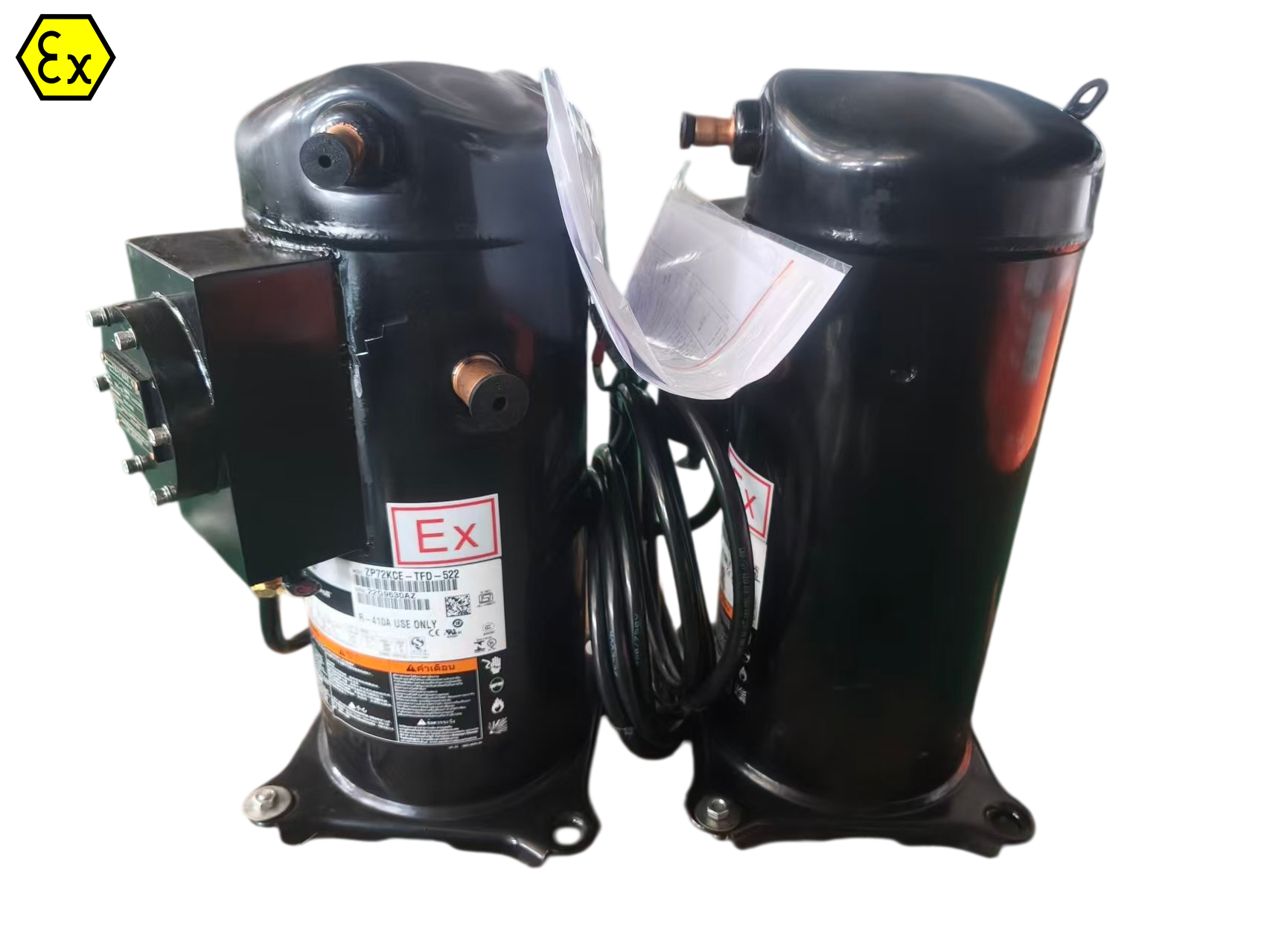

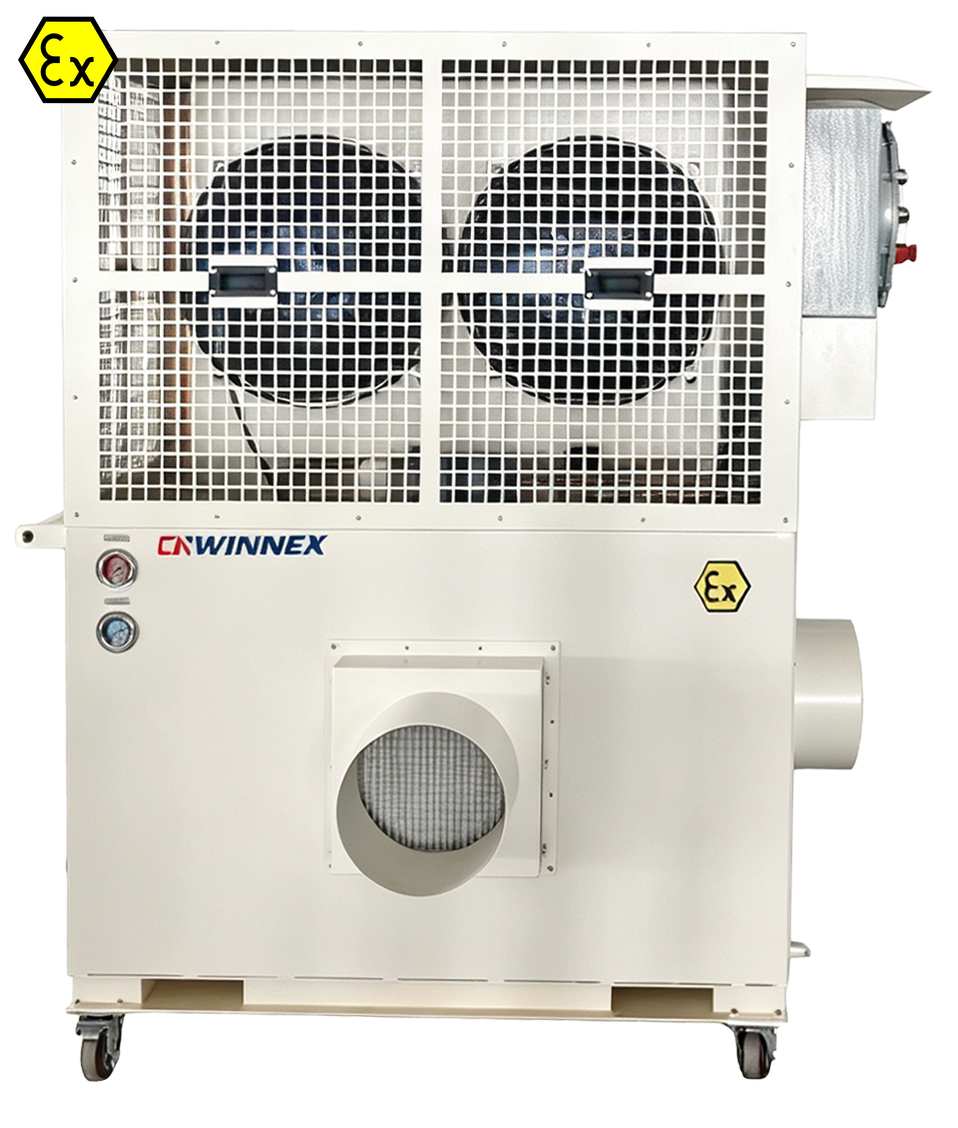
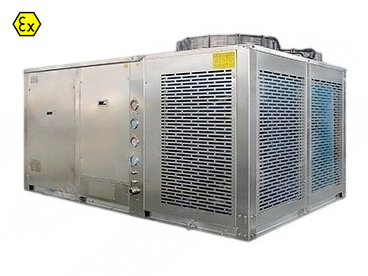
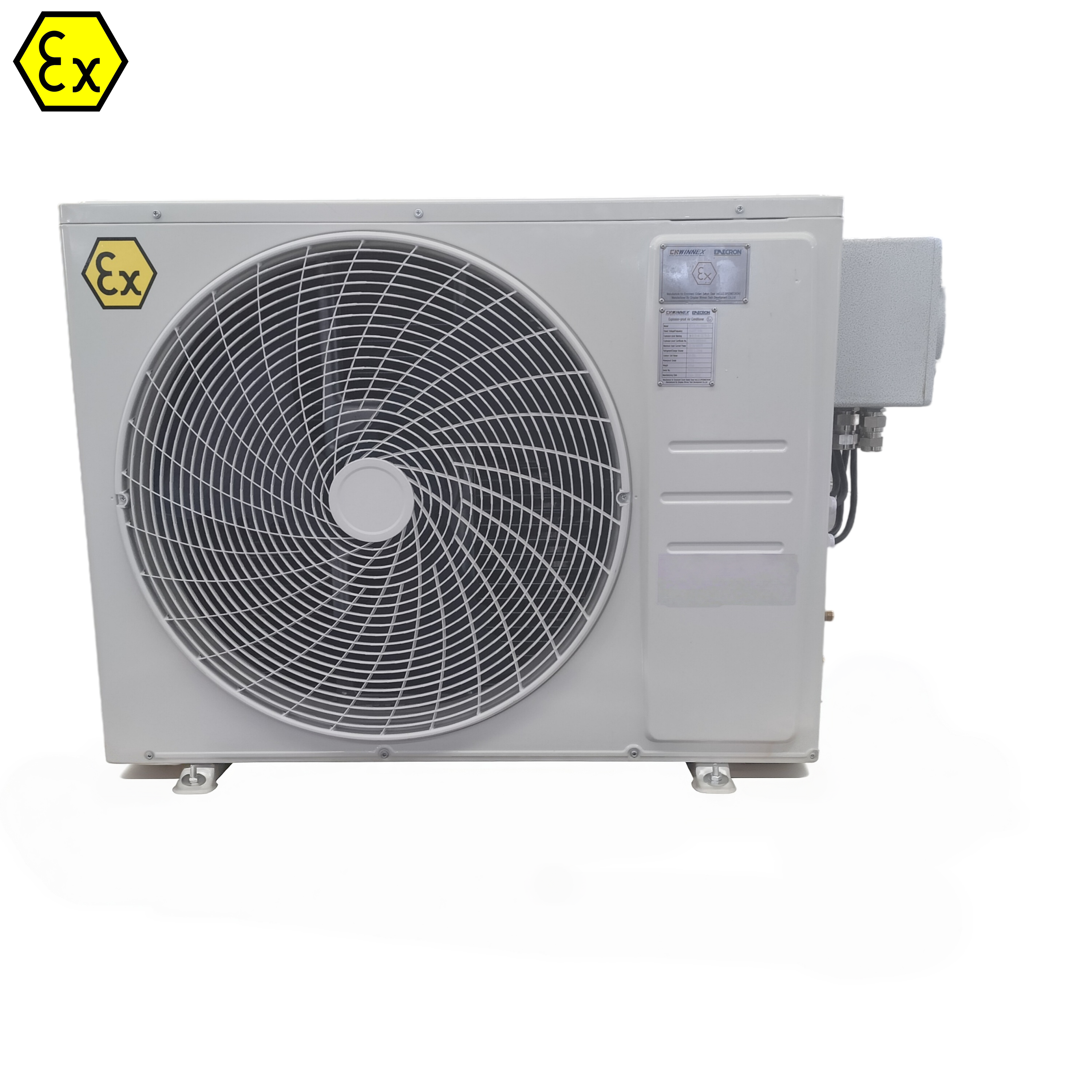
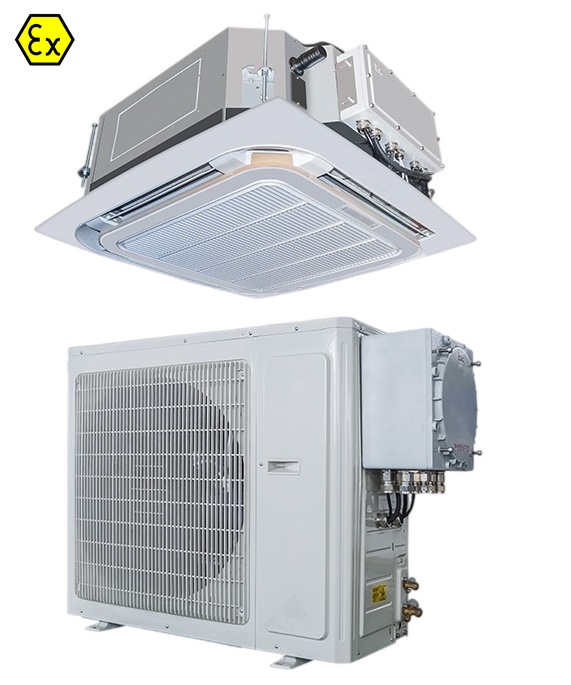
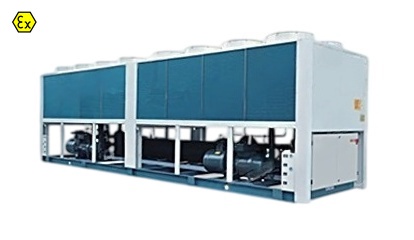
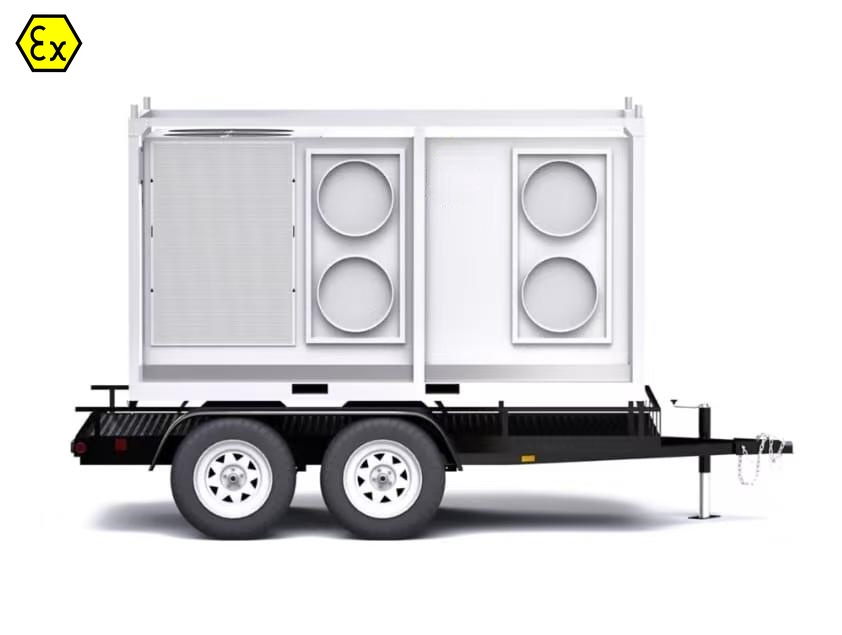

CNWINNEX’s affiliated company is China’s only independently IECEx-certified explosion-proof compressor manufacturer. Certifed to IEC 60079-0/-2/-7/-11/-18, marking Ex eb ib mb pxb IIC T4 Gb, -25°C to +60°C. The compliant core inside CNWINNEX explosion-proof air conditioners.
CNWINNEX Affiliated Company: China’s Only Independently IECEx-Certified Explosion-Proof Compressor Manufacturer — The Compliant Core Inside Every CNWINNEX Explosion-Proof Air Conditioner
The compliance of an explosion-proof air conditioner begins with its most critical component. CNWINNEX’s affiliated company is China’s only explosion-proof compressor company holding an independent IECEx certificate—a qualification whose significance lies not in the document itself, but in the fact that it places the most critical moving part of an explosion-proof air conditioner within an independent, traceable, and verifiable international compliance framework. In oil and gas, chemical, offshore, and hazardous-material storage applications, the compressor is both the heart of the refrigeration cycle and a potential ignition source. The depth of a compressor’s explosion-proof compliance directly determines the safety margin and certification credibility of the complete unit in Zone 1 and Zone 2 hazardous areas.
IECEx: The Common Language of Global Explosion-Proof Equipment
IECEx is the global explosion-proof certification system established by the International Electrotechnical Commission, built on the IEC 60079 series of standards and providing broad mutual recognition of test and certification results among member countries. Unlike certification paths limited to a single country or region, an IECEx certificate represents a cross-border technical consensus: the equipment’s design, manufacturing, and testing have been independently verified within an internationally recognized framework. For explosion-proof air conditioners serving global hazardous-area projects, an independent IECEx certificate at the compressor level means one less “supplementary certification” gap in the complete-unit compliance chain, and one more layer of technical evidence that owners, EPC contractors, and third-party reviewers can independently verify.
The Standards Matrix Behind the Certificate: Five Core IEC 60079 Standards
The IECEx certificate covers not a single protection concept, but a standards matrix built on five IEC 60079 series standards:
- IEC 60079-0:2017 — General requirements for equipment in explosive atmospheres, the foundational framework for all specific protection standards;
- IEC 60079-2:2014 — Protection by pressurized enclosure “p,” maintaining a protective gas at a pressure above the external atmosphere to prevent explosive gases from entering the equipment enclosure;
- IEC 60079-7:2017 — Increased safety “e,” applying additional measures to raise safety levels and limit spark and high-temperature risks;
- IEC 60079-11:2011 — Intrinsic safety “i,” restricting circuit energy to levels incapable of igniting an explosive atmosphere;
- IEC 60079-18:2017 — Encapsulation “m,” isolating components that may produce sparks or high temperatures from the explosive atmosphere through encapsulating materials.
A compressor that simultaneously covers pressurization, increased safety, intrinsic safety, and encapsulation—unified under the general requirements framework—indicates that its explosion-proof design is not a reactive measure against a single risk, but a systematic control of ignition sources, energy pathways, and environmental isolation.
Marking Interpretation: The Technical Depth of Ex eb ib mb pxb IIC T4 Gb
The compressor carries the explosion-proof marking Ex eb ib mb pxb IIC T4 Gb, with an ambient temperature range of -25°C ≤ Tamb ≤ +60°C. Each element of this marking carries distinct engineering meaning:
- eb (Increased Safety) — Electrical connections and insulation systems are reinforced to reduce the probability of sparks or hazardous temperatures under normal operation;
- ib (Intrinsic Safety) — Control and signal circuits are restricted to intrinsically safe energy levels, incapable of ignition even under fault conditions;
- mb (Encapsulation) — Critical electrical components are physically isolated from the external explosive atmosphere through encapsulation;
- pxb (Pressurization) — A positive protective gas pressure is maintained inside the enclosure, preventing external explosive gases from entering the equipment from the source;
- IIC — Covers the most hazardous gas groups, including hydrogen and acetylene, reaching the highest level in the gas-group dimension;
- T4 — Maximum surface temperature does not exceed 135°C, positioned in the upper-middle safety range of the T1 to T6 classification;
- Gb — Equipment Protection Level suitable for Zone 1 and Zone 2 explosive gas atmospheres.
The stacking of four protection concepts on a single component carries a clear engineering implication: protection-layer redundancy. Even if one layer degrades under sustained operation, thermal cycling, or vibration, the remaining mechanisms continue to form an effective safety barrier. For an explosion-proof air conditioner, this means the compressor’s explosion-proof integrity is not dependent on a single mechanism, but rests on multiple independent lines of defense.
What This Means for CNWINNEX Explosion-Proof Air Conditioner Customers
This independent compressor IECEx certificate translates into three project-level certainties for CNWINNEX air conditioner users:
Independent traceability of core-component compliance. In technical reviews for hazardous-area projects, reviewers frequently require separate traceability for critical components. An independent IECEx certificate at the compressor level allows the complete-unit compliance chain to extend beyond a blanket “unit certification” down to the core moving component, forming a more complete evidence chain.
A clearly defined explosion-proof boundary for wide-temperature operation. The -25°C to +60°C ambient range covers conditions from cold regions to high-temperature oil and gas stations. Within this boundary, the compressor’s explosion-proof integrity has undergone standardized thermal-cycle verification, providing underlying support for stable operation in desert, offshore, and extreme-climate applications.
Market-access efficiency across multiple jurisdictions. Leveraging the mutual recognition foundation of the IECEx system, CNWINNEX explosion-proof air conditioners equipped with this compressor can reduce the compliance verification cost and cycle for core components when entering different regional markets, minimizing repeated unit-level approvals caused by component-level certification gaps.
Applications
As a core component, this explosion-proof compressor is integrated across CNWINNEX split wall-mounted, packaged, rooftop packaged, and mobile packaged explosion-proof air conditioner lines, serving thermal control systems in:
- Oil & gas / petrochemical — Explosion-proof electrical control rooms and analyzer shelters in refinery process units, oil and gas stations, and gas processing facilities;
- Offshore & marine — Explosion-proof cabins and equipment rooms on offshore platforms and FPSOs (primarily fixed-installation configurations);
- Chemical & hazardous materials — Fine chemical workshops, hazardous-material storage, and battery production and storage areas;
- Power & special industries — Explosion-proof electrical equipment rooms, control cabins, and temporary or fixed work spaces requiring Zone 1/2 thermal control.
Request Compressor IECEx Documentation and Explosion-Proof AC Selection Support — To review the IECEx certificate and standards-compliance documentation for this explosion-proof compressor, or to consult on explosion-proof air conditioner selection based on your hazardous area classification, gas group, temperature class, and cooling load, please contact the CNWINNEX engineering team.
Leave A Reply
Please give us a message