

Categories List
Recent Posts
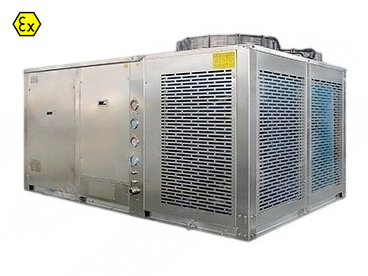
 CNWINNEX Rooftop Packaged Explosion-Proof Air Conditioner: 200kW All-in-One Thermal Control That Rethinks Installation for Marine & Offshore Hazardous AreasLarge-capacity climate control in hazardous areas has long carried a structural contradiction. Split explosion-proof systems distribute the compliance burden across indoor units, outdoor units, refrigerant piping, and on-site coordination—each interface a potential gap in the certification chain and a drag on project schedules. Conventional floor-standing or cabinet units, meanwhile, consume premium work area in spaces where every square meter already carries operational and safety value. The CNWINNEX Rooftop Packaged Explosion-Proof Air Conditioner resolves this by moving integration upstream: cooling, heating, humidification, steam heating, and the complete explosion-proof electrical control system are assembled and factory-tested in a single rooftop monoblock. On site, only power, water, and duct connections remain. With 200kW rated cooling and heating capacity and 36,000 m³/h airflow, it delivers centralized, uniform thermal control within an ATEX Zone 1/2 compliance envelope.
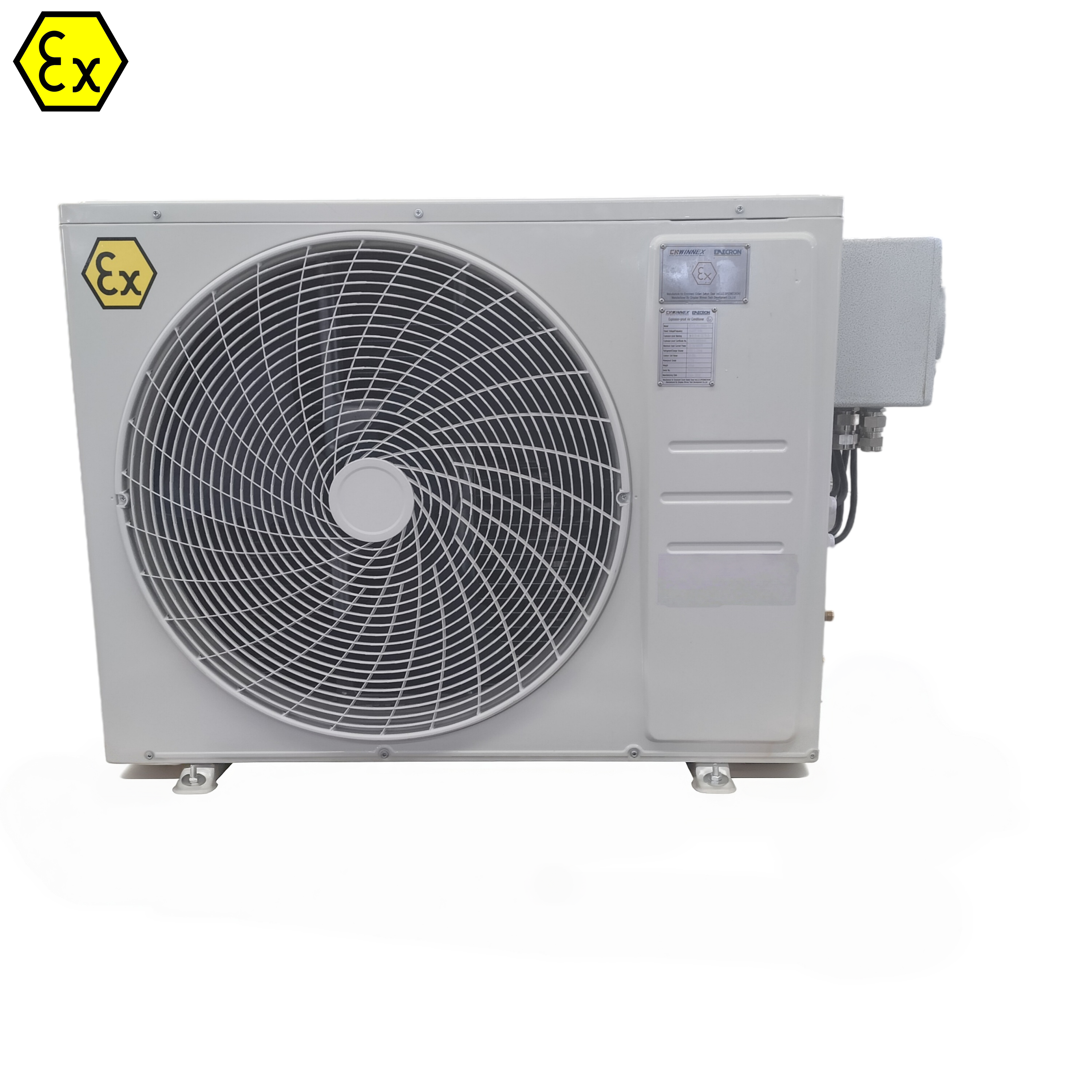
 CNWINNEX Explosion-Proof Split Wall-Mounted Air Conditioner: Wide-Temperature Cooling from -7℃ to 55℃ for ATEX Zone 1 & 2 Hazardous SitesIn oil and gas stations, chemical plants, and high-temperature work zones on offshore platforms, the question is not whether an air conditioner can cool—it is whether it can keep cooling when the ambient temperature pushes past 55℃, while simultaneously meeting the non-negotiable compliance requirements of Zone 1 and Zone 2 hazardous areas. Safety and performance are not a trade-off. They are the baseline.
The CNWINNEX split wall-mounted high-temperature explosion-proof air conditioner is engineered for exactly this intersection. It delivers stable cooling across a -7℃ to 55℃ ambient range, operating reliably through both extreme heat and sub-zero cold. With explosion protection marking Ex db mb IIC T4 Gb, it is suitable for Zone 1 and Zone 2 explosive gas atmospheres and designed in strict compliance with ATEX Directive 2014/34/EU. CNWINNEX Engineering Explosion-Proof AC Systems for 50°C OperationDesigning cooling equipment for 50°C ambient conditions compounds the challenges of explosion protection. Heat rejection becomes progressively more difficult as the temperature differential between the condenser and surrounding air shrinks. A unit rated for 35°C ambient may lose 30% or more of its cooling capacity at 50°C—assuming it continues operating at all. Material selection determines whether components survive sustained thermal stress: seals that remain flexible at moderate temperatures can harden and crack at 50°C, compromising both explosion protection and refrigerant containment; lubricants thin under heat, accelerating bearing wear; electronic control boards experience accelerated aging when junction temperatures climb.
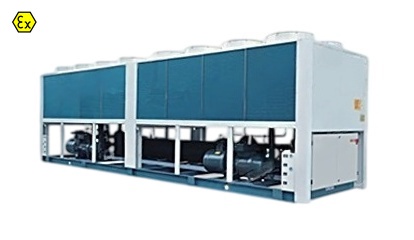
 CNWINNEX Explosion-Proof Screw Air-Cooled Chiller (Heat Pump) | Explosion-Proof Chiller for Petrochemical & Chemical IndustriesThe CNWINNEX explosion-proof screw air-cooled chiller (heat pump) is designed and manufactured in strict compliance with the EN 60079 series explosion protection standards and conforms to ATEX Directive 2014/34/EU, featuring reliable quality and superior explosion-proof performance. The unit is mainly suitable for the petroleum, chemical, electric power, military and pharmaceutical industries, and is applied in hazardous areas of Zone 1 and Zone 2 where explosive atmospheres formed by flammable gases or vapours of Group ⅡA, ⅡB, ⅡC and temperature classes T1~T4 mixed with air may exist. Explosion-proof marking: Ex db mb IIC T4 Gb, suitable for Zone 1 and Zone 2 explosive hazardous areas. With advanced twin screw compression technology, intelligent control system and reliable explosion-proof design, the unit provides efficient, stable and energy-saving chilled (or hot) water supply for high-hazard industrial sites.
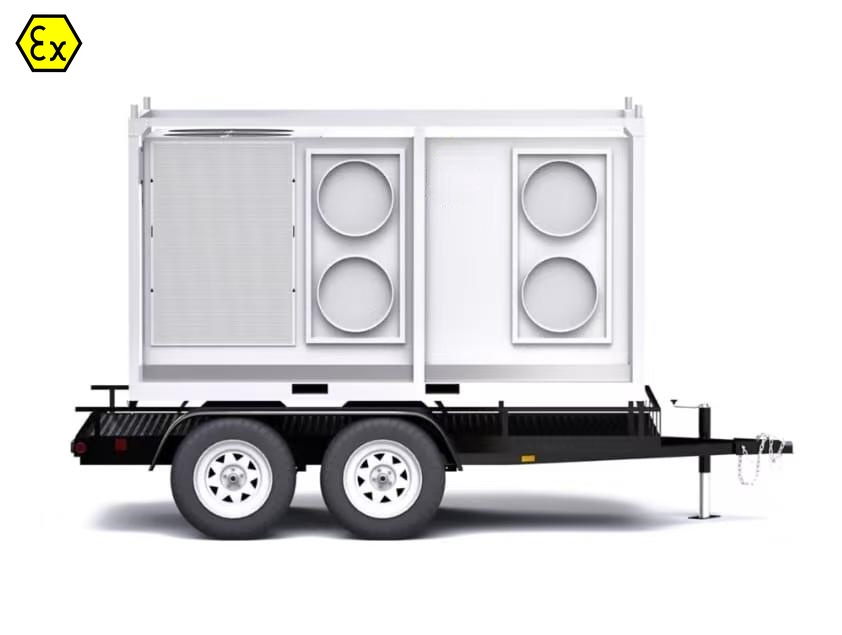
 CNWINNEX Trailer Type Packaged Explosion-Proof Air Conditioner BKT-65 | 68kW Mobile Industrial Explosion-Proof ACThe CNWINNEX trailer type packaged explosion-proof air conditioner (BKT-65) is a mobile integrated air conditioning unit specially developed for explosive hazardous areas in the petroleum, chemical, electric power, military and pharmaceutical industries. It is suitable for sites where explosive atmospheres formed by flammable gases or vapours of Group ⅡA, ⅡB, ⅡC and temperature classes T1~T4 mixed with air may exist. The unit is designed and manufactured in strict compliance with ATEX Directive 2014/34/EU and the EN 60079 series explosion protection standards. Explosion-proof marking: Ex db ib mb IIC T4 Gb, suitable for Zone 1 and Zone 2 explosive hazardous areas. Complete explosion-proof technical documentation is supplied to support HSE review and site acceptance for projects worldwide. The trailer-mounted packaged design enables rapid relocation and plug-and-play operation, delivering stable and reliable cooling for high-temperature and high-hazard work sites.
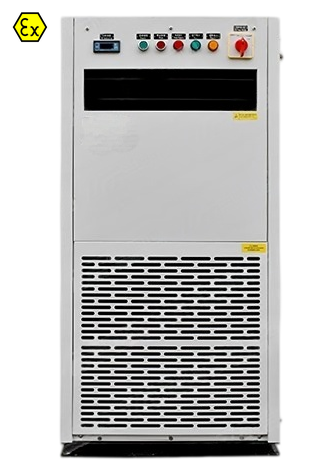
 CNWINNEX High-Temperature Cabinet Air Conditioner | 53℃~85℃ Desert High-Temp Industrial Explosion-Proof ACThe CNWINNEX high-temperature cabinet explosion-proof air conditioner is specially developed for hazardous sites with high ambient temperature (53℃~85℃) where flammable and explosive gases or dust exist, suitable for explosive gas atmospheres of Group ⅡA, ⅡB, ⅡC and temperature classes T1~T4 in Zone 1 and Zone 2 hazardous areas. The unit is designed and manufactured in strict compliance with ATEX Directive 2014/34/EU and the EN 60079 series explosion protection standards. Explosion-proof marking: Ex db mb IIC T4 Gb, suitable for Zone 1 and Zone 2 explosive hazardous areas. Operating stably in high-temperature harsh environments, the unit effectively lowers local ambient temperature and provides a comfortable and safe working and living environment for personnel. It is widely applied in high-temperature or desert regions such as the Middle East, Africa, South America and Xinjiang in China, as well as in the petroleum, chemical, metallurgical, electric power and pharmaceutical industries
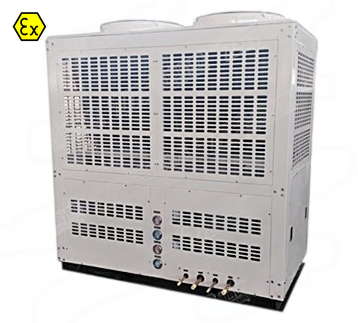
 CNWINNEX Explosion-Proof Air-Cooled Chiller | ATEX Certified Industrial Explosion-Proof ChillerThe CNWINNEX explosion-proof air-cooled chiller is designed and manufactured in strict compliance with ATEX Directive 2014/34/EU and the EN 60079 series explosion protection standards, ensuring reliable quality and superior explosion protection performance. It is suitable for hazardous areas where explosive atmospheres formed by flammable gases or vapours of Group ⅡA, ⅡB, ⅡC and temperature classes T1~T4 mixed with air may exist. Explosion-proof marking: Ex db mb IIC T4 Gb, suitable for Zone 1 and Zone 2 explosive hazardous areas. Complete explosion-proof technical documentation is supplied to support HSE review and site acceptance for petroleum, chemical, electric power, military and pharmaceutical projects worldwide.
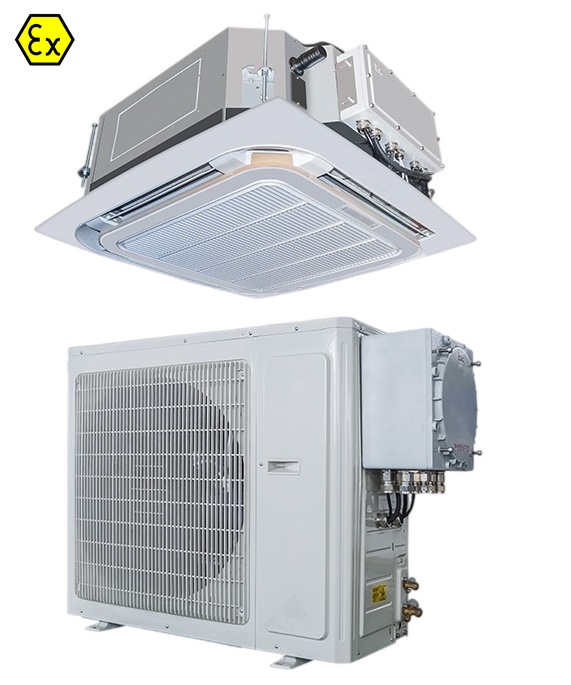
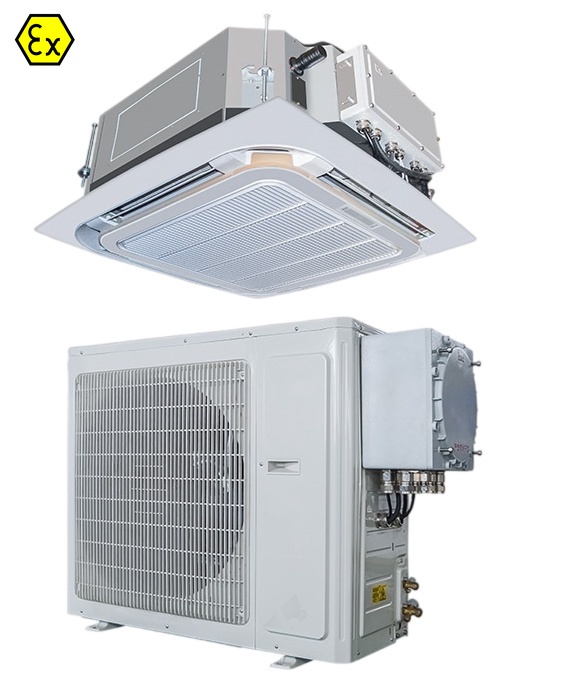
- CNWINNEX Explosion-Proof Ceiling Cassette Air Conditioner | Flush-Mounted Industrial Explosion-Proof Cassette ACThe CNWINNEX explosion-proof ceiling cassette air conditioner adopts an internationally leading ultra-low voltage technology to isolate intrinsically safe circuits. Manufactured with special processes and explosion protection treatment, it fully meets explosion protection requirements and is widely used in hazardous areas where explosive atmospheres formed by flammable gases or vapours of Group ⅡA, ⅡB, ⅡC and temperature classes T1~T4 mixed with air may exist. The unit is designed and manufactured in strict compliance with ATEX Directive 2014/34/EU and the EN 60079 series explosion protection standards. Explosion-proof marking: Ex db mb IIC T4 Gb, suitable for Zone 1 and Zone 2 explosive hazardous areas. Complete explosion-proof technical documentation is supplied to support HSE review and site acceptance for chemical, oil & gas and pharmaceutical projects worldwide.

CNWINNEX Rooftop Packaged Explosion-Proof Air Conditioner: 200kW All-in-One Thermal Control That Rethinks Installation for Marine & Offshore Hazardous Areas
CNWINNEX Rooftop Packaged Explosion-Proof Air Conditioner: 200kW All-in-One Thermal Control That Rethinks Installation for Marine & Offshore Hazardous Areas
Large-capacity climate control in hazardous areas has long carried a structural contradiction. Split explosion-proof systems distribute the compliance burden across indoor units, outdoor units, refrigerant piping, and on-site coordination—each interface a potential gap in the certification chain and a drag on project schedules. Conventional floor-standing or cabinet units, meanwhile, consume premium work area in spaces where every square meter already carries operational and safety value. The CNWINNEX Rooftop Packaged Explosion-Proof Air Conditioner resolves this by moving integration upstream: cooling, heating, humidification, steam heating, and the complete explosion-proof electrical control system are assembled and factory-tested in a single rooftop monoblock. On site, only power, water, and duct connections remain. With 200kW rated cooling and heating capacity and 36,000 m³/h airflow, it delivers centralized, uniform thermal control within an ATEX Zone 1/2 compliance envelope.
As industries such as petrochemicals, power, offshore, and new energy continue to raise compliance expectations for climate control in hazardous areas, the rooftop packaged format competes not on a single specification but on its ability to compress explosion-proof compliance, high-capacity heating/cooling, and on-site deployment efficiency into one deliverable unit.
Why Rooftop Packaged Architecture Creates Engineering Certainty in Marine & Offshore Projects
In a split explosion-proof system, on-site work is fragmented across indoor unit protection, outdoor unit placement, refrigerant piping, and whole-system Ex coordination. The rooftop packaged approach relocates that work to the factory: the refrigeration circuit, explosion-proof electricals, air supply, and humidification are integrated and tested before shipment, leaving only power, water, and duct interfaces at the point of installation. For shipyards with constrained commissioning windows and offshore platforms where lifting and hot-work permits govern the schedule, this “arrive-nearly-commissioned” delivery model translates directly into schedule certainty and audit-ready compliance traceability. The monoblock configuration also eliminates refrigerant piping as a persistent leak and maintenance vector—explosion-proof integrity no longer depends on the field quality of multi-trade coordination.
Rooftop mounting is itself a spatial strategy. The unit occupies neither floor nor wall work area; inside the enclosure, only supply and return air openings remain. In densely packed electrical rooms, control cabins, and hazardous-material storage spaces, the reclaimed usable area has tangible operational value.
Ex db ib mb IIC T4 Gb: Triple Protection as System Redundancy, Not Label Stacking
The marking Ex db ib mb IIC T4 Gb reflects the coordination of three distinct protection philosophies: flameproof enclosures (db) contain internal ignition and prevent flame propagation; intrinsically safe circuits (ib) cap ignition energy in control and signal paths below hazardous thresholds; and encapsulation (mb) seals critical electrical components against gas or dust ingress. The significance of the combination lies in redundancy: if one protection layer degrades under prolonged salt spray, vibration, or thermal cycling, the remaining layers preserve the unit's explosion-proof integrity. This architecture qualifies the unit for Zone 1 and Zone 2 explosive gas atmospheres, covering gas groups ⅡA/ⅡB/ⅡC and temperature classes T1 through T4.
In marine and offshore service, Ex compliance is the floor, not the differentiator. The BKT-200 platform pairs that compliance with Copeland / Emerson hermetic or semi-hermetic scroll compressors in a dual configuration (2 × 26kW); copper-tube, copper-fin evaporator and steam heater; and a horizontal shell-and-tube condenser rated for ≤32℃ inlet water, compatible with marine seawater cooling systems. Refrigerant options include R410A / R407C / R134a. The 18.5kW explosion-proof centrifugal fan delivers adjustable external static pressure of 200–300 Pa for duct runs of varying length. The 4,000kg unit is reinforced for persistent offshore vibration and salt-spray exposure, giving marine engineers predictable lifting and securing parameters alongside its thermal performance.
Who Specifies a Rooftop Packaged Explosion-Proof Unit
● Offshore oil & gas platforms and FPSOs — Centralized temperature and humidity control for control rooms, electrical houses, and accommodation modules. Rooftop placement preserves internal module space; 200kW dual heating/cooling capacity covers concentrated loads without distributed indoor equipment.
● Ocean-going vessels and LNG/LPG carriers — Climate control for explosion-proof equipment rooms and compartments adjacent to hazardous cargo zones. The packaged format shortens shipboard installation and commissioning; the seawater-compatible condenser integrates with the vessel's central cooling system.
● Hazardous-material storage and chemical plant areas — Large warehouse spaces, lithium battery production shops, and fine chemical units. Rooftop central air supply achieves temperature uniformity across large volumes, with Ex ratings covering combined gas and dust risk profiles.
● Offshore wind substations and marine modules — Cooling for explosion-proof electrical equipment rooms, matched to modular fabrication and lift-into-place construction sequences.
● Request a Project Configuration Share your hazardous area classification (Zone 1/2), gas group and temperature class, heating/cooling loads, seawater cooling availability or air-cooled constraints, vessel grid specification, and lifting/installation limits. The CNWINNEX engineering team will return an ATEX-compliant BKT-200-based rooftop packaged configuration and delivery plan matched to your project conditions.
Leave A Reply
Please give us a message