

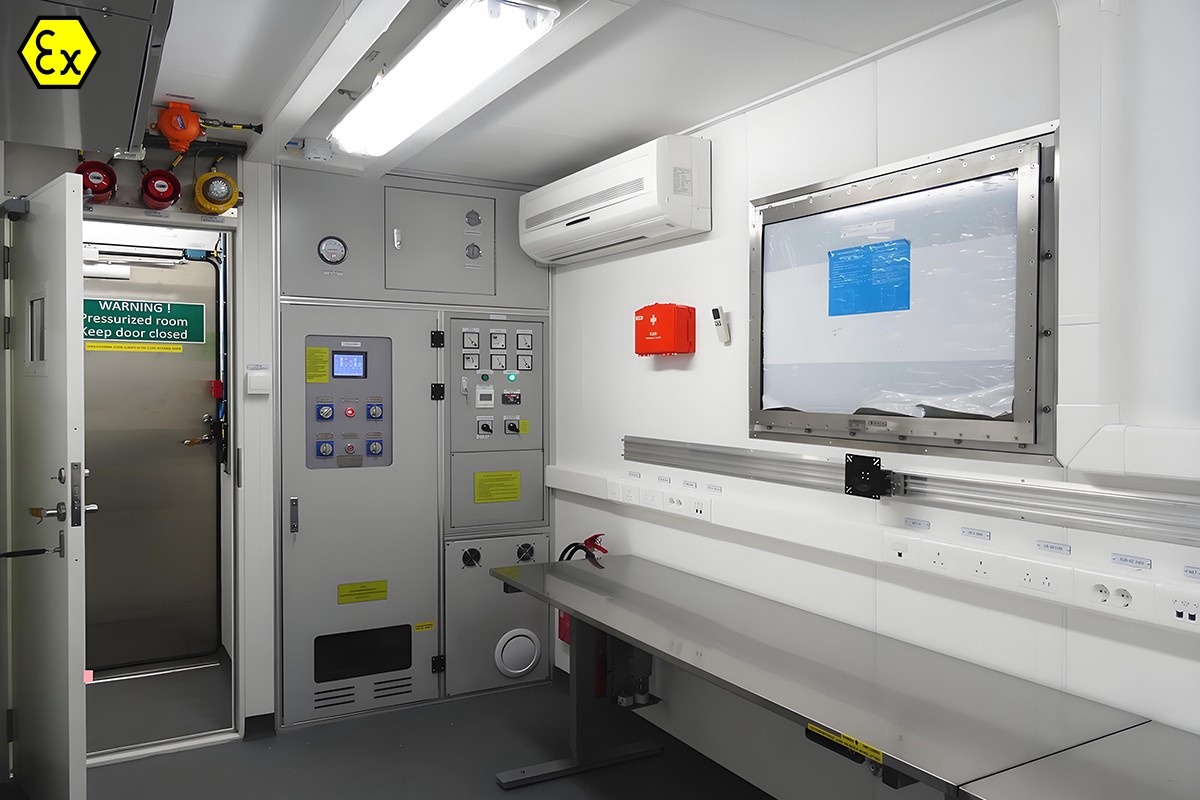
Explosion Proof Pressurized Analysis Cabin
● Class IIA, IIB, IIC explosive gas environment in Zone 1, Zone 2 and Explosive Dust Environment in Zone 21 and Zone 22
● Temperature Group: T1-T4
● Indoor and Outdoor IP65
● Used in hazardous places such as Applicable to flammable and explosive industries such as petroleum, chemical, military, pharmaceutical, and warehousing;
Application Scope
● Class IIA, IIB, IIC explosive gas environment in Zone 1, Zone 2 and Explosive Dust Environment in Zone 21 and Zone 22
● Temperature Group: T1-T4
● Indoor and Outdoor IP65
● Used in hazardous places such as Applicable to flammable and explosive industries such as petroleum, chemical, military, pharmaceutical, and warehousing;
● Implementation Standards: ATEX EN60079, GB/T 3836.1-2021, GB/T 3836.2-2021, GB/T 3836.3-2021, GB/T 3836.4-2021, GB/T 3836.17-2019.
● Explosion Proof Mark: Ex dB e bib mb pb IIB T4 Gb; Ex db e bib mb pb IIC t4 Gb
● Working Voltage: AC220V AC380V AC660V
● Supporting Auxiliary Equipment: Explosion Proof Air Conditioner 1.5 or 2 Horse Power, Explosion Proof Oil-Filed Heater 2KW, Explosion Proof Fluorescent Lamp 2x40W or 2x20W, Explosion Proof
Emergency Lamp: 1x20W, Explosion Proof Gas Detector
● Ventilation Mode: Continuous + Clearance
● The Ventilation interface is G1/2,G3/4,or G1, the gas consumption is about 100-300m3/h, and the gas supply pressure is 0.4-1.0 Mpa
● The protection grade is IP54 and IP65.
System Composition:
● Main body of the hut (double layer structure, filled with thermal insulation and fireproof materials)
● Indoor hazardous gas concentration monitoring system
● Audible and visual alarm interlocking system
● Equipment power distribution system
● Power supply and remote signal transfer signal box.
● Pressurized control system
Analysis of cabin structure and external facilities
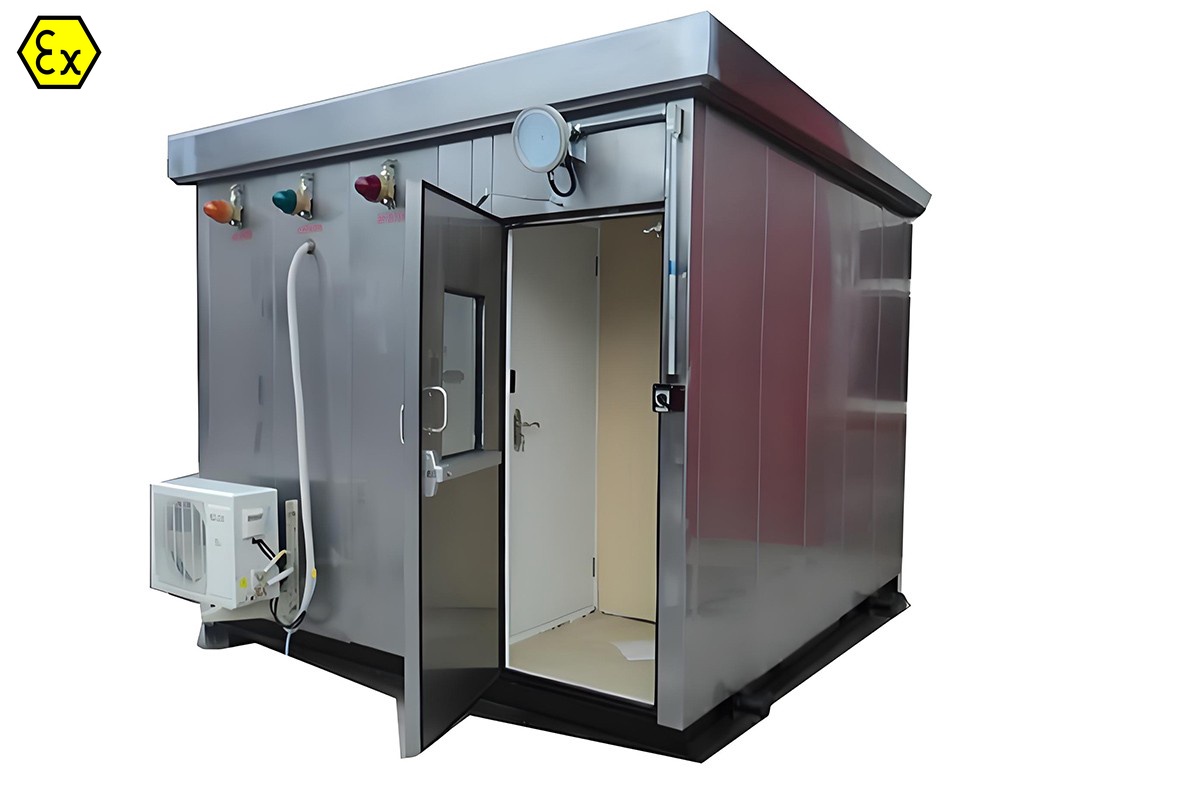
The metal structure explosion proof cabin is a non-standard product. Its size can be determined according to the number, type of equipment, system complexity and operation and maintenance space, and there should be appropriate space left. Limited by long distance transportation conditions, its shape size is generally as follows: reference length: outdoor body 2.5-8m. References width: Outdoor body 2.5m, Maximum width should not exceed 3.0m(Limited by road transport width, width should not exceed 3.0m). Reference height 2.7-3.0m for outdoor main body (Limited by height when passing overpasses or tunnels), 2.5-2.8m for indoor net height.
Mechanical Structure and Material Requirements
● Framework, Base and Roof
The framework, base and roof or the explosion proof cabin are metal components, welded with section steel, and shall have sufficient strength and rigidity to ensure that the explosion proof analysis cabin will not deform during loading, lifting, translation and transportation.
The roof shall have a certain slope, with a slope of at least 4%. It can be in A-Shape or slope structure. Flat roof is not allowed to prevent rainwater accumulation.
● Internal and External Walls, Internal and External Roof Panels
The external wall panel should be made of 1.5mm #-2.0mm steel plate. The external wall can be formed by the profiled plate assembly structure. 304 Stainless Steel wire drawing and laminating plate can be also used. When using the cold-rolled steel plate, the surface must be sprayed with white or international gray. The internal wall panel and ceiling are made of 1.5mm#-2.0mm steel plate, and the material is cold-rolled steel plate, or stainless steel plate can be used according to user requirements. When cold rolled sheet is used, the surface must be sprayed with white gloss paint for ceiling and white matte paint for internal wall panel.
The roof panel must have effective rain proof design, which can use the assembled rain proof design of buckle structure or the pane welded rain-proof design. The materials is the made of 1.5mm#-2.0mm stainless steel plate to ensure the durability of corrosion resistance of the roof surface. The bearing capacity of the outer roof is ≥250Kg/m2 (the weight of two people) without permanent deformation.
● Thermal Insulation Layer
Flame retardant thermal insulation materials (Mineral Wool, etc) are filled between the internal and external walls, and internal and external roof. The thickness of the thermal insulation layer is generally 70-75mm(3min), and it should be thickened to 80-85mm in cold or hot areas.
● Floor
The floor is made of anti-skid metal plate, which should be made of 4-6mm steel plate. The material can be patterned stainless steel plate, patterned galvanized steel plate or hot-rolled steel plate according to the user’s requirements. The galvanized steel plate or hot-rolled steel plate must be sprayed on the surface. The spraying colour is generally gray. If necessary, a layer of anti-static plastic plate can be added.
● Door
The cabin has an open door, non-foldable structure with thermal insulation layer. The size of door is usually 2000(H)x900(W)x50mm, in order to ensure no air leakage in the cabin after the staff enter or leave the cabin, there is a separate buffer compartment inside ( the net size of buffer compartment is about 1200x1200), which is equipped with an additional door, all with glass windows( the size of 400) as required and the size of the main door x400),All doors are made of the same material as the external wall of the cabin. Hinges and screws are made of stainless steel with external locking mechanism. There is rubber sealing strip between the door and the wall. The temperature resistance of rubber strip is -25-+60℃.Doors and windows should be fitted on each door. The area of doors and windows should be no less than 0.4m2. Flameproof glass should be used for window and doors. The whole door body, including the windows and doors, should be able to withstand the impact of 2kg/cm2 in both directions. The door is equipped with a damp limit closer, a push-rod escape lock and a lock and a handle outside the door.
External Facilities of Explosion Proof Analyzer House
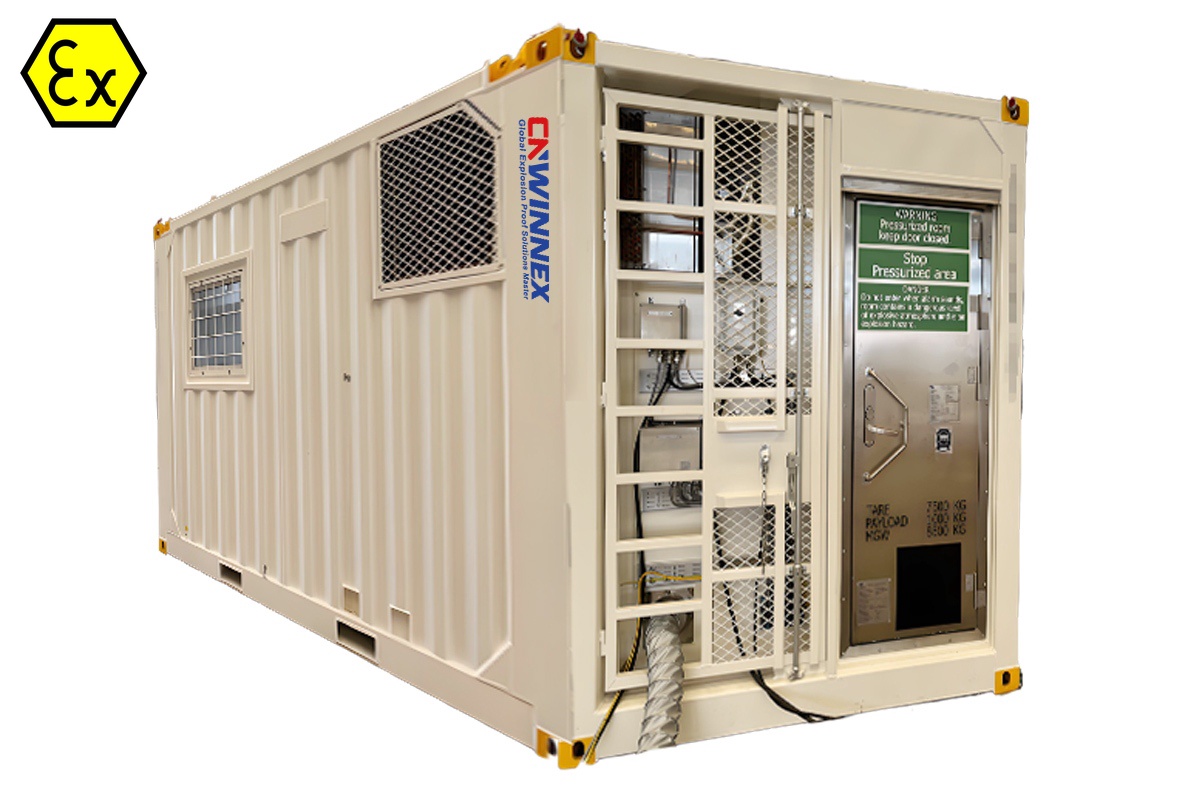
The cabin is equipped with a gas cylinder fixing bracket with a protective chain, which is used to place the gas carrying steel cylinder and standard gas cylinder. If necessary, the gas cylinder guardrail can be added to prevent irrelevant personnel from approaching. In the cold area or in the harsh environment, a gas cylinder room can also be separated in the cabin. The gas cylinder from should be equipped with a separate door, lighting and ventilation facilities. (This item is optional).
The door ,junction box, gas cylinder rack and sample pretreatment box shall be provided with rain-proof edge above, or the roof of the shed shall be extended for 600-800mm to cover the rain.
The top of the cabin shall be equipped with lifting rings for overall hoisting.
The power distribution system of explosion proof cabin is : lighting ,ventilation, heating, air conditioning and internal instrument equipment.
The lighting , ventilator, air conditioner, maintenance socket and other public equipment of the analyzer house are powered by industrial power supply. The analyzer system, installation detection alarm and interlocking system are powered by UPS.
The distribution is as following:
The instrumented distribution of public distribution boxes should be independent of each other and should not be combined with a single junction box of distribution box. Power sources of different voltages levels ( such as 380V AC, 220V AC, UPS,24V DC) should also be independent of each other and should not be combined with a single junction box or distribution box.
The power junction box should be located outside the cabin, and the power cord should be connected to the analysis cabin through the junction box.
The main power switch should be located outside the cabin to disconnect the power supply when dangerous conditions occur in the cabin.
The distribution box is located inside the cabin ,and each instrument and equipment should be supplied with power and wiring separately.
Each distribution circuit should be equipped with its own fuse protection device and manual switch.
At least one backup circuit should be left for both public distribution and instrumentation distribution.
Electrical equipment, such as power switches, distribution boxes, etc, should meet the requirements of protection and explosion prevention at the installation site. When installed outside the cabin, the protection level should not be lower than IP55. Ex db eb type should be chosen as explosion proof form. The illumination level in the explosion proof cabin is generally 250-3001x for operation and maintenance. Incident lighting should be equipped with inverters and accumulators. The standby time for power outage should not be less than 30 minutes, and the lighting should be suitable for dangerous area in Zone 1. Lighting switches should be installed next to the main door outside the analysis cabin, using explosion proof power switches. For easy night maintenance, explosion proof lighting and explosion proof lighting switches should be provided above the sample handing boxes and bottle guards outside the analysis cabin.
Ventilation, Heating and Air Conditioning
● Ventilation
The explosion proof cabin is generally equipped with explosion proof centrifugal fan or explosion proof axial flow fan. When the relative density of harmful gases that may exist in the cabin is less than 1, the fan should be installed at the upper part of the cabin, and when the relative density is more than 1, the fan shall be installed at the lower part of the cabin. The fan switch is generally installed next to the outdoor main door and adopts explosion proof power switch.
● Heating
The temperature in the explosion proof cabin is generally controlled in the range of 10-30℃. In winter, the explosion proof electric heating fan or explosion proof oil-filling heater can be used. The surface temperature of the heating surface should not exceed the allowable temperature of the regional danger level, and is shielded by the shield to prevent burns caused by direct contact with the human body.
● Air Conditioning
In order to meet the requirements of the internal operating environment temperature of the explosion proof cabin in summer, the cabin is equipped with explosion proof air conditioners, including window type, wall mounted type and floor standing type, which can be selected as required. Natural ventilation is adopted for the ventilation of common analyzer house. It is caused by external wind force or internal and external heat gradient. In order to strengthen the ventilation effect, mechanical ventilation equipment is often supplemented. Such as installing ventilation fan or exhaust fan.
The explosion proof analyzer house has the following advantages
The analyzer system can be fully tested under simulated operating conditions, and the design, equipment and installation defects can be corrected before delivery to the site. This is crucial to ensure the smooth operation of the system and reduce the amount of the on-site maintenance.
The integrator’s factory installation is not affected by the site climate and construction conditions.
The system integrator should be responsible for the design, installation, commissioning, and operation of the whole system and provide turnkey project.
It can avoid the troubles and errors caused by the coordination and docking of various design disciplines and construction types in the field installation ,and improve the reliability of the system.
All system files are separate files provided by the integrator.
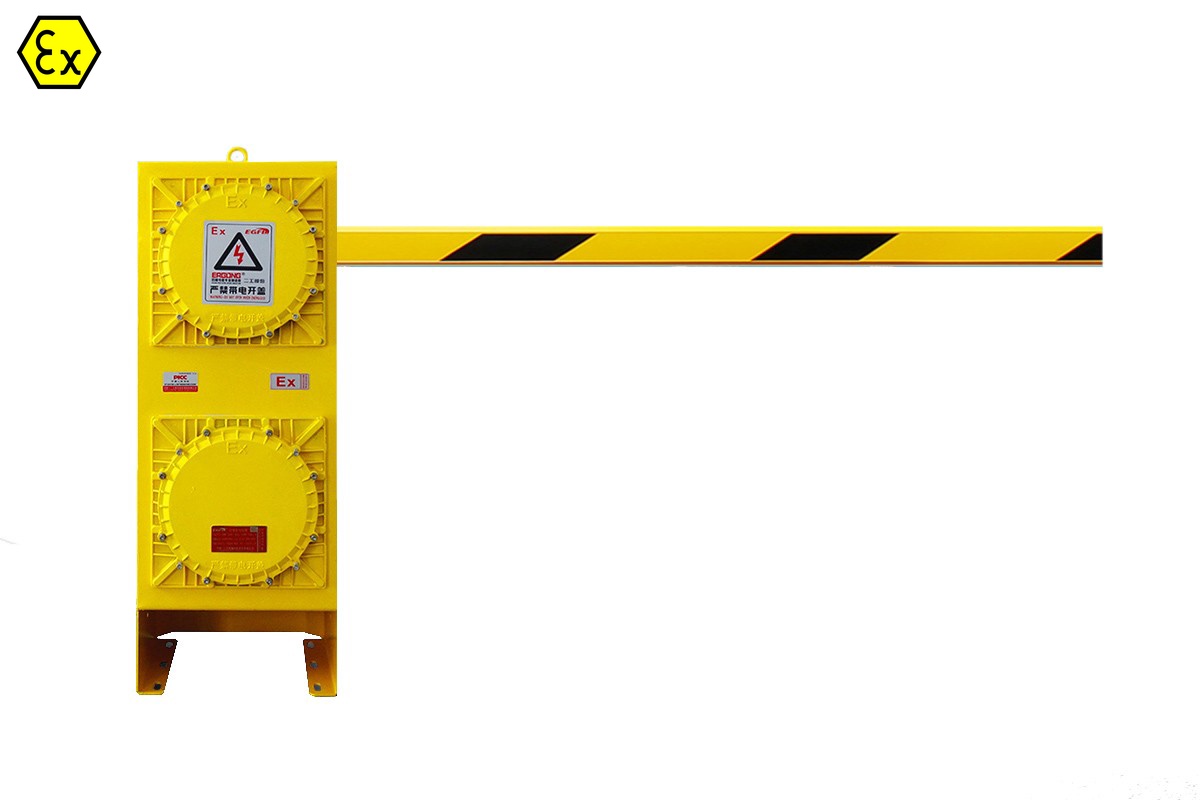
CNWINNEX explosion-proof systems are widely deployed in oil & gas, petrochemicals, pharmaceuticals, ports & terminals, mining, power generation, offshore platforms, and other areas where flammable gases or dusts are present. Typical applications include control room climate control, hazardous area logistics and access management, video surveillance & security, pressurized analyzer shelters, robotic inspection, as well as custom explosion-proof enclosures and system integration.
An explosion-proof air conditioner is a specialized HVAC unit designed for hazardous environments where flammable gases, vapors, or combustible dusts are present (e.g., petrochemical plants, gas stations, paint booths, pharmaceutical labs).
The most critical difference from a standard air conditioner lies in “active ignition prevention.” Standard units generate tiny sparks during normal operation – such as when relays open/close, compressors start/stop, or circuits make/break. While safe in normal air, these sparks can be deadly in an explosive atmosphere.
CNWINNEX’s explosion-proof design is based on the T4 temperature class. For high-temperature regions such as the Middle East or areas with extreme summer heat, we offer custom units rated for ambient temperatures up to 60°C (140°F) , ensuring reliable operation without overload in harsh tropical climates. For cold regions, we offer custom units rated for ambient temperatures as low as -50°C (-58°F) , guaranteeing safe operation in extreme arctic conditions.
The explosion-proof rating of CNWINNEX air conditioners is:
Ex 2 G D Ex db ib mb IIB T4 Gb / Ex 2 G D Ex db ib mb IIC T4 Gb / Ex ib mb tb IIIC T130°C Db
●For Gas (G): Ex db ib mb IIC T4 Gb
Suitable for IIC gas groups (including hydrogen, acetylene, etc.), using flameproof (db), intrinsic safety (ib), and encapsulated (mb) combined protection. Temperature class T4 (max surface temperature ≤135°C), Equipment Protection Level Gb.
●For Dust (D): Ex ib mb tb IIIC T130°C Db
Suitable for IIIC conductive dusts, using intrinsic safety (ib), encapsulation (mb), and dust-tight (tb) protection. Maximum surface temperature 130°C, Equipment Protection Level Db.
CNWINNEX products comply with international explosion-proof certification standards such as ISO, CNEX, ATEX, IECEx, SAA, EAC, ensuring safe use in different countries and regions., and BV or DNV (for offshore applications) . Depending on the product type and zone classification, we offer various protection concepts including Ex d, Ex e, Ex ib, and Ex nA, with ingress protection up to IP66/IP67, ensuring safe and compliant operation in hazardous environments worldwide.
Absolutely. Explosion-proof Custom Engineering is our sixth core business. From non-standard Ex components (special material junction boxes, intrinsically safe sensors, etc.) to integrated Ex systems (skid-mounted control rooms, pressurized cabins, legacy equipment retrofitting), we provide full-process custom services covering conceptual design, 3D simulation, compliance certification, manufacturing, and delivery. Simply share your operating parameters and functional needs, and we will engineer a dedicated explosion-proof safety solution for you.

Please give us a message