

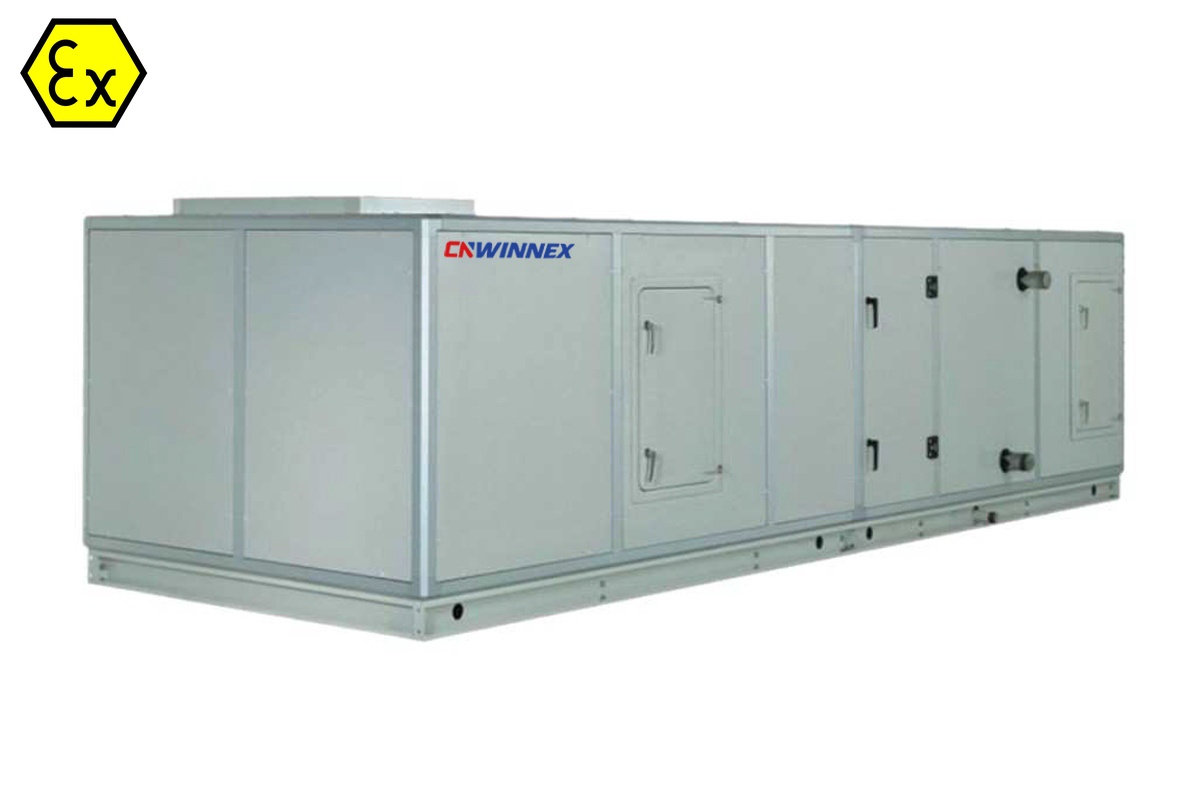
Explosion-Proof Modular Air Handling Unit (AHU)
2 Excellent Quality: Components such as fans, motors, heat exchangers, and control systems use well-known brand products, ensuring reliable performance and long service life.
3 Modular Design: Adopts modular design, making the combination of design and functional sections more flexible.
4 High-Efficiency Cooling Coil: The cooling coil is made of copper tubes and corrugated aluminum fins integrally stamped by dedicated molds, mechanically expanded. Seamless steel pipes are used as headers, equipped with air vent valves to expel air, ensuring high-efficiency heat exchange performance.
5 Sturdy and Durable Casing, Good Thermal Insulation, Excellent Sealing
1) The unit adopts a built-in steel str
Product Features
1 The explosion-proof modular air handling unit can realize multiple air handling functions such as supply air, cooling, heating, humidification, dehumidification, air purification, and sound attenuation, meeting the requirements of different usage conditions and various installation methods.
2 Excellent Quality: Components such as fans, motors, heat exchangers, and control systems use well-known brand products, ensuring reliable performance and long service life.
3 Modular Design: Adopts modular design, making the combination of design and functional sections more flexible.
4 High-Efficiency Cooling Coil: The cooling coil is made of copper tubes and corrugated aluminum fins integrally stamped by dedicated molds, mechanically expanded. Seamless steel pipes are used as headers, equipped with air vent valves to expel air, ensuring high-efficiency heat exchange performance.
5 Sturdy and Durable Casing, Good Thermal Insulation, Excellent Sealing
1) The unit adopts a built-in steel structure frame, providing a solid structure with good mechanical strength.
2) Panels use double-layer steel plates with an internal reinforcing frame, filled with polyurethane insulation material for good thermal insulation; all panels are fastened from the inside to the frame with screws, ensuring no condensation on the unit's surface.
3) The unique insulated access door structure, integrally molded and combined with multi-lip rubber seals, greatly improves the unit's airtightness, ensuring no thermal bridges and no condensation.
4) Sealing strips are used between panels and the frame, ensuring the unit's airtightness and thermal insulation.
5) Panels are made of high-quality steel plates treated with processes like pickling, cleaning, phosphating, drying, electrostatic spraying, and baking, ensuring aesthetics and durability.
6 Low Noise and Low Vibration
1) Vibration Isolation Design: Vibration isolators (rubber or shear-type spring) are installed under the fan and motor supports based on different fan vibration frequencies, ensuring good vibration damping efficiency. Flexible connections are installed at the fan outlet.
2) Sound Attenuation Design: Utilizes micro-perforated panel broadband silencers, providing effective noise reduction.
7 Dry Drain Pan Design: The bottom of the drain pan has a certain slope towards the drain outlet, ensuring smooth drainage of condensate and keeping the pan dry after the external drain pipe is installed.
8 Convenient Installation, Commissioning, and Maintenance: Small units are shipped assembled; large units are manufactured in sections. Sections are connected by bolts, requiring no special tools.
Introduction to Main Functional Sections
1. Fan Section
1) All units use explosion-proof double-inlet centrifugal fans. Based on the required fan total pressure, three fan types are available: forward-curved, backward-curved, and airfoil. All fan impellers undergo static and dynamic balancing tests.
2) Multiple fan configurations are available for each model to meet different user requirements.
3) Uses explosion-proof motors from famous brand manufacturers, offering stable and reliable performance, high protection grade (IP rating), and good explosion-proof properties.
4) The fan and motor are mounted on the same base. Rubber or shear-type spring vibration isolators are selected between the base and the casing based on vibration frequency for effective damping. Flexible connections link the fan outlet to the casing.
5) The fan and motor are connected via V-belt drive.
2. Coil Section
1) Cooling and hot water heating coils are made of copper tubes and corrugated aluminum fins integrally stamped by dedicated molds, mechanically expanded. Steam heating coils are made of steel tubes with wound steel fins. Coil frames are made of galvanized steel sheet.
2) Seamless steel pipes are used as headers. Air vent valves are installed at the highest point of the header to ensure heat exchange performance. Drain ports are designed at the lowest point of the header to prevent coil freezing in winter. Headers have external thread connections. Coil working pressure is 1.0MPa, pneumatic test pressure is 1.2MPa.
3) Adopts dry drain pan design. The pan bottom has a sloped drain outlet to ensure smooth condensate drainage and keep the pan dry.
4) Coil inlet and outlet can use flange connections; customization available for special requirements.
3. Humidification Section
1) Humidification methods can be isothermal or isenthalpic.
● Isothermal Humidification: Dry steam humidification, electrode humidification, electric heating humidification, etc.
● Isenthalpic Humidification: Wetted media humidification, high-pressure spray humidification, spray chambers, etc.
● For applications with a steam source and high humidity requirements, dry steam or electrode humidification is recommended. For comfort air conditioning without a steam source and with less critical humidity control, wetted media or high-pressure spray humidification can be used.
2) When using isenthalpic humidification, note the following:
● A pre-heater may be needed before the humidifier to enhance humidification effect.
Humidification is accompanied by a temperature drop.
● Saturation efficiency limit: Humidification capacity cannot be increased by increasing water supply once the saturation efficiency point of the humidifier is reached.
● High water consumption, low effective humidification efficiency. Effective humidification rate is about 30-35% (except for recirculating water wetted media humidifiers).
● For wetted media humidifiers, if the face velocity exceeds 2.8 m/s, a droplet eliminator should be installed to prevent water carryover.
4. Filtration Section
1) Standard Configuration
● Aluminum Mesh Filter: Consists of double-layer aluminum mesh with a nylon mesh layer. Suitable for general air conditioning spaces with low filtration requirements.
● Primary Filter: Available in panel and bag types. Uses synthetic fiber media. Filtration efficiency G3-G4. Cleanable.
● Medium Filter: Available in panel and bag types. Uses synthetic or glass fiber media. Filtration efficiency F5-F8.
● Standard nominal dimensions for panel and bag type primary/medium filters are 610×610mm, 610×508mm, 610×305mm. These are international standard sizes, ensuring good interchangeability.
2) Optional Configurations
● High-Medium/Sub-HEPA filters: Filters with efficiency F9-H13 can be selected based on user requirements.
● Chemical filters: Use activated carbon adsorption media to effectively remove harmful gases and odors from the air.
3) Filter Selection Notes
● Filters below F5 efficiency can be used directly as pre-filters without a front-end protective filter.
● Filters with efficiency F5 or higher should have a protective pre-filter upstream, with a 2-4 grade difference between stages.
● Medium and high-efficiency filters should preferably be located in the positive pressure section of the unit.
Cross-Section Air Volume Table
Cooling Performance Table
1. Standard Rating Conditions
Notes:
1. Entering air: DB 27°C, WB 19.5°C; Entering water: 7°C, Leaving water: 12°C;
2. The table shows coil cooling capacity. Unit cooling capacity is the total capacity minus motor heat gain.
Outdoor Air Conditions
Notes:
1. Entering air: DB 35°C, WB 28°C; Entering water: 7°C, Leaving water: 12°C;
2. The table shows coil cooling capacity. Unit cooling capacity is the total capacity minus motor heat gain.
Cooling Performance Table (Combined Cooling/Heating Coil - Standard Rating Conditions)
1. Standard Rating Conditions
Note: Entering air DB 15°C.
2. Outdoor Air Conditions
Note: Entering air DB 15°C.
Cooling Performance Table (Hot Water Coil and Steam Coil)
1. Standard Rating Conditions
Note: Entering air DB 15°C.
2. Outdoor Air Conditions
Note: Entering air DB 7°C.
Electrical and Automation Control System Introduction
1. Standard Type:
The standard air handling unit does not include an electrical control system. Only terminal leads are provided via a junction box.
2. Programmable Control System
This system uses a PLC controller or a Direct Digital Controller (DDC), suitable for constant temperature and humidity control of the air handling unit. It sequentially acquires operating parameters and statuses of relevant functional sections, implements ON/OFF or continuous control of actuators based on specific control logic and algorithms. This achieves correct operation sequences, timed start/stop, runtime accumulation, load balancing, energy saving while meeting control accuracy requirements, and equipment safety protection. It allows setting and displaying various operating indicators, statuses, and fault alarms.
3. Centralized Monitoring and Remote Monitoring System
Air handling units equipped with complete control devices can form a two-level distributed monitoring system with a central management computer (typically a PC) via standard RS485, RS422, or RS232 interfaces. This system can display the operating status of multiple units within 1000 meters graphically to the operator. It allows controlling start/stop, parameter setting, and recording/printing operating status and fault information for any unit. Multiple central management computers can form a remote monitoring system with an off-site monitoring center via telephone lines. Hardware utilizes standard communication interfaces; software implements standard communication protocols and allows co-development of network control systems with third parties. The centralized monitoring system can be an integral part of the building automation system.
Unit Installation Precautions
1. The installation foundation must be level. Drains and floor drains should be provided around the foundation. The foundation height should be approximately 200mm to facilitate the installation of a U-shaped water seal. The water seal height = 1.5 × Unit Static Pressure (Pa) / 10 (mm) to ensure smooth condensate drainage.
2. Place a layer of rubber pad between the unit base and the foundation to improve vibration damping and noise reduction.
3. When assembling modular units, add sealing strips between sections.
4. When piping the coils, connect according to the labels on the unit. Piping must have independent supports; do not allow the piping weight to be borne by the unit. It is advisable to install a water strainer on the inlet pipe to prevent debris from blocking the heat exchanger. Water treatment (softening) is recommended to reduce scaling.
5. Piping for the steam heating section should comply with relevant heating specifications.
6. Use flexible connections between unit outlets/inlets and ductwork. Ductwork must have independent supports; never allow duct weight to be borne by the unit.
7. Verify the unit power supply is 380V-3PH-50Hz. Check that the fan rotation direction is correct.
8. The working pressure for cooling coils and hot water heaters should not exceed 1.0MPa. The supply pressure for steam heaters should not exceed 0.4MPa for saturated steam.
9. Before normal operation, remove all debris, check all equipment, and ensure water, electrical, and air circuits are clear.
10. When starting the unit, check the balance of the three-phase motor current and check that the fan bearing temperature rise is within the normal range.
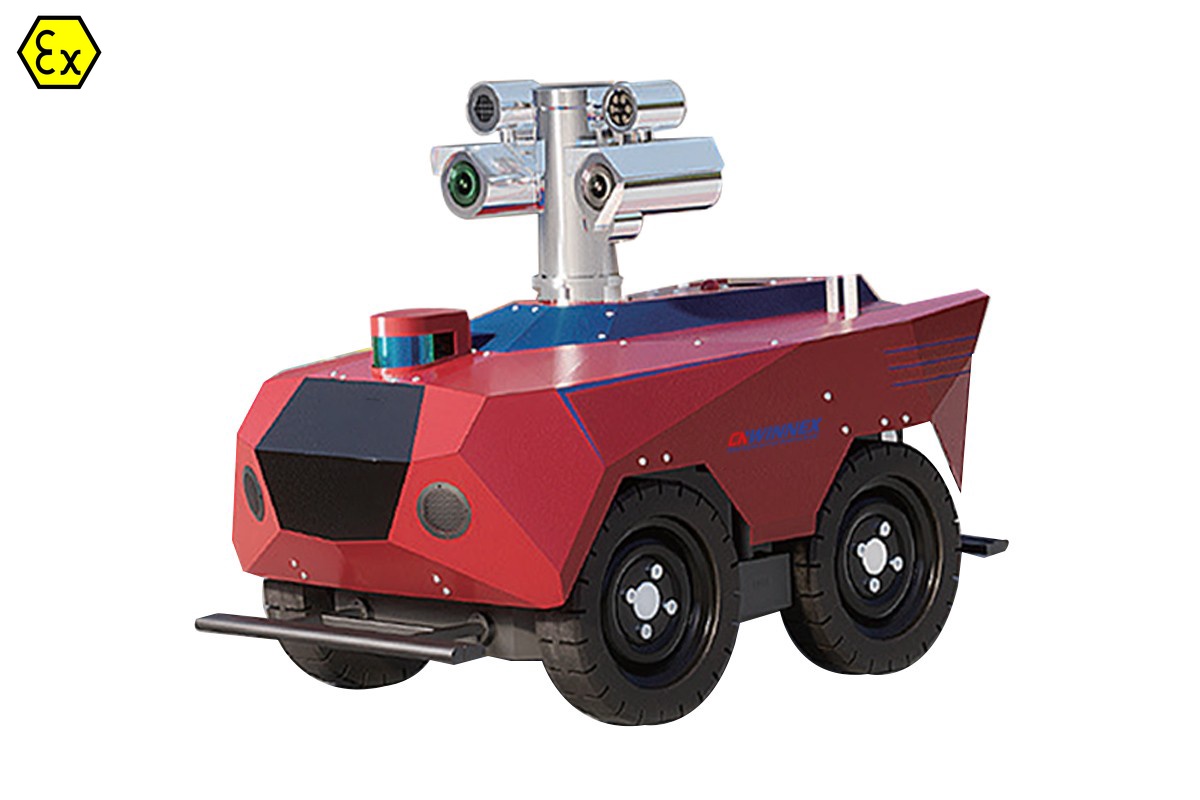
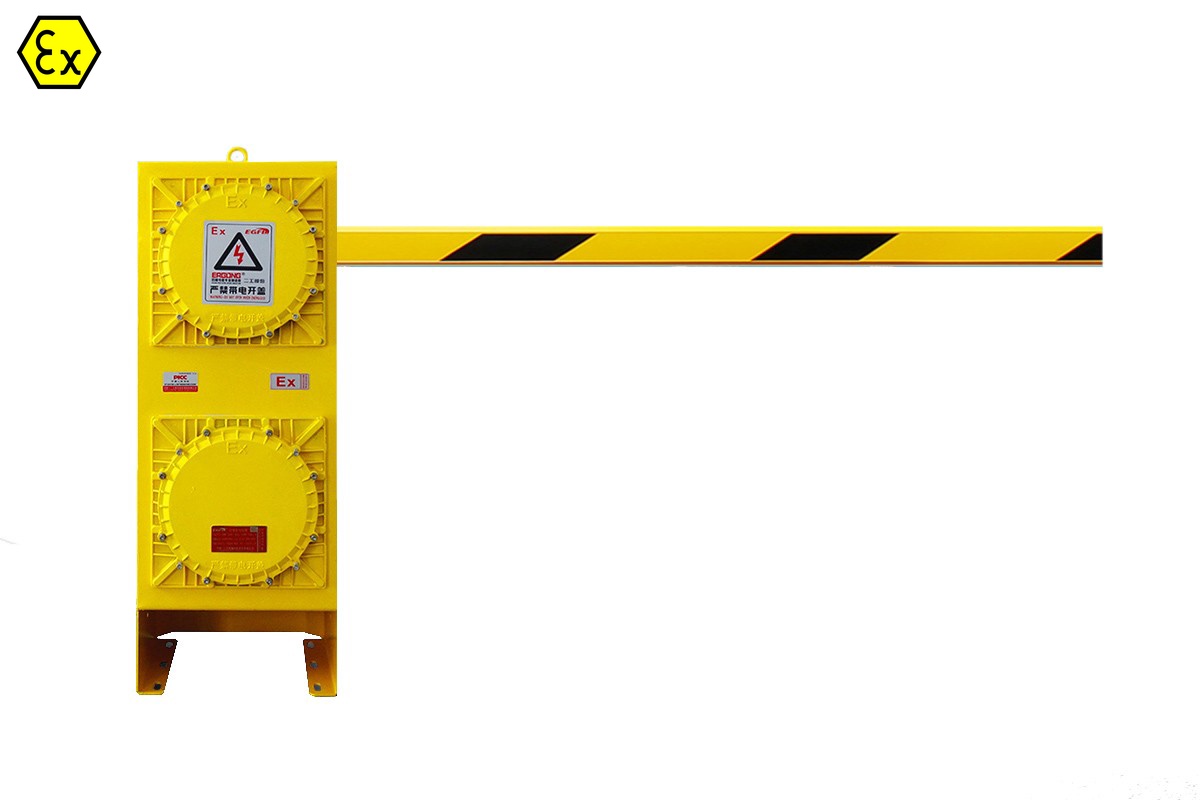
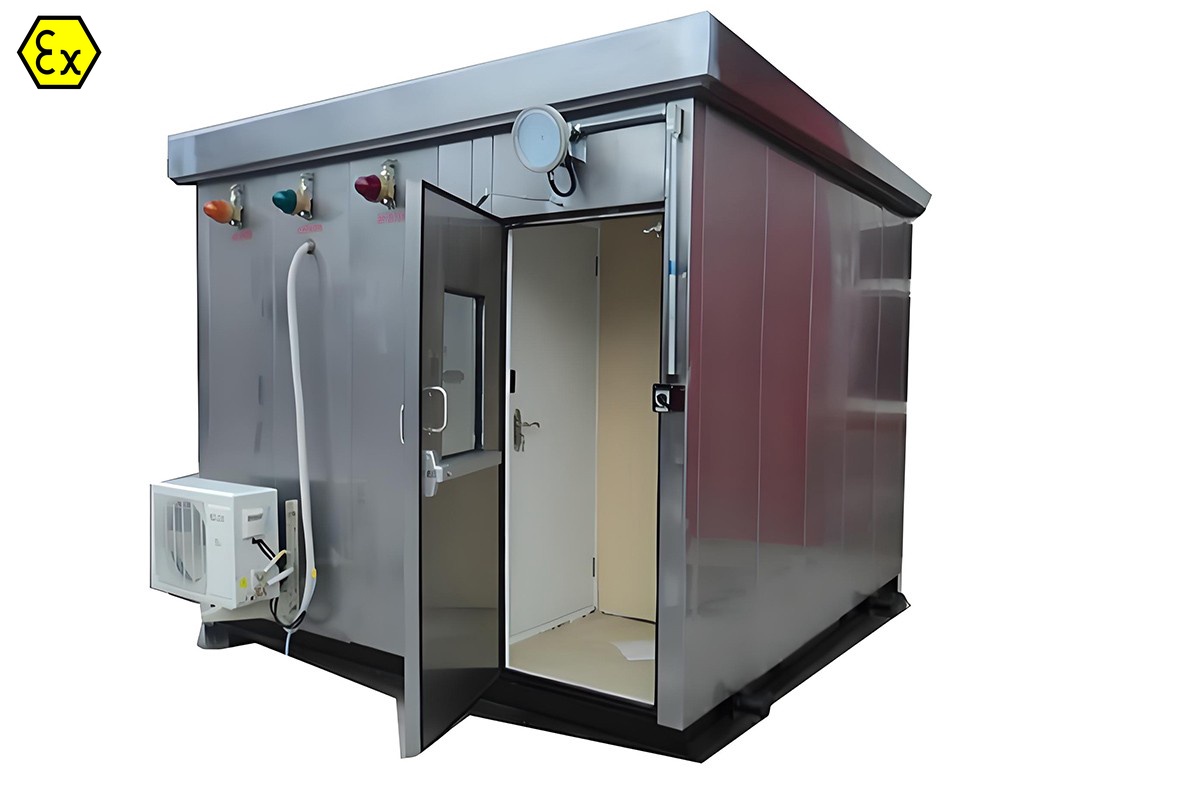
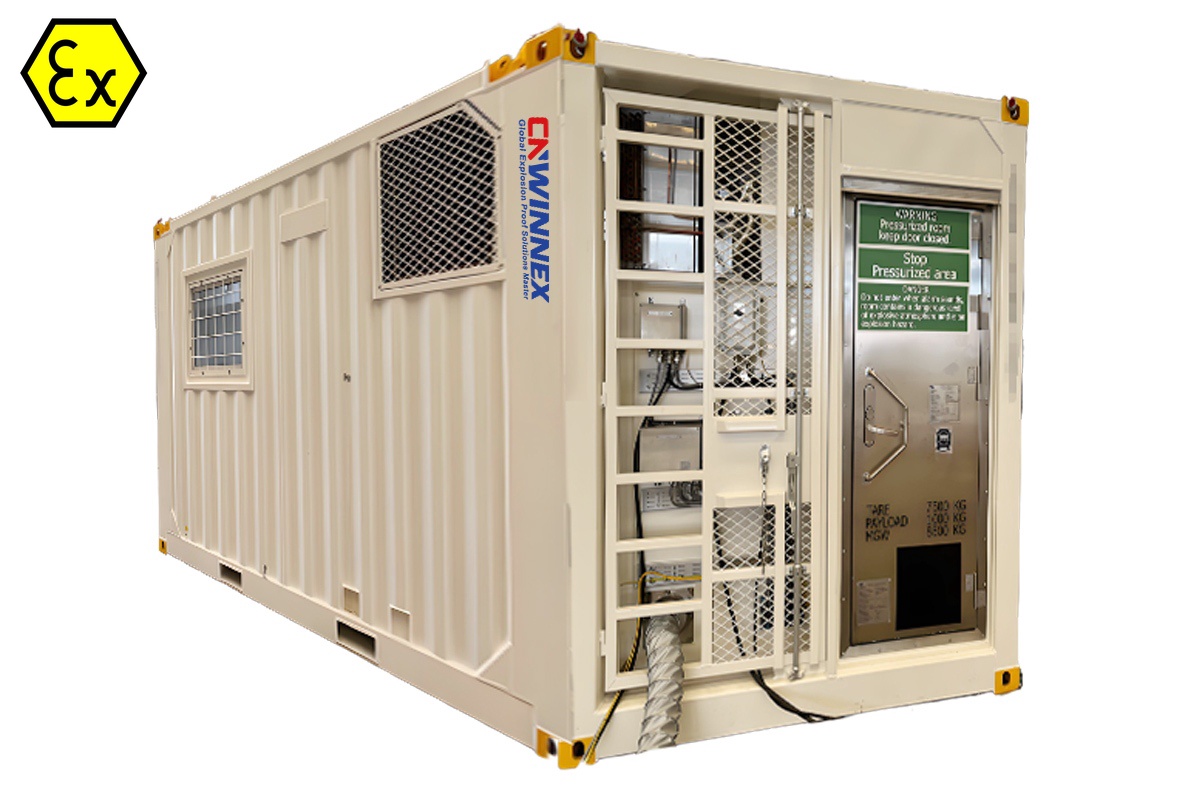
CNWINNEX explosion-proof systems are widely deployed in oil & gas, petrochemicals, pharmaceuticals, ports & terminals, mining, power generation, offshore platforms, and other areas where flammable gases or dusts are present. Typical applications include control room climate control, hazardous area logistics and access management, video surveillance & security, pressurized analyzer shelters, robotic inspection, as well as custom explosion-proof enclosures and system integration.
An explosion-proof air conditioner is a specialized HVAC unit designed for hazardous environments where flammable gases, vapors, or combustible dusts are present (e.g., petrochemical plants, gas stations, paint booths, pharmaceutical labs).
The most critical difference from a standard air conditioner lies in “active ignition prevention.” Standard units generate tiny sparks during normal operation – such as when relays open/close, compressors start/stop, or circuits make/break. While safe in normal air, these sparks can be deadly in an explosive atmosphere.
CNWINNEX’s explosion-proof design is based on the T4 temperature class. For high-temperature regions such as the Middle East or areas with extreme summer heat, we offer custom units rated for ambient temperatures up to 60°C (140°F) , ensuring reliable operation without overload in harsh tropical climates. For cold regions, we offer custom units rated for ambient temperatures as low as -50°C (-58°F) , guaranteeing safe operation in extreme arctic conditions.
The explosion-proof rating of CNWINNEX air conditioners is:
Ex 2 G D Ex db ib mb IIB T4 Gb / Ex 2 G D Ex db ib mb IIC T4 Gb / Ex ib mb tb IIIC T130°C Db
●For Gas (G): Ex db ib mb IIC T4 Gb
Suitable for IIC gas groups (including hydrogen, acetylene, etc.), using flameproof (db), intrinsic safety (ib), and encapsulated (mb) combined protection. Temperature class T4 (max surface temperature ≤135°C), Equipment Protection Level Gb.
●For Dust (D): Ex ib mb tb IIIC T130°C Db
Suitable for IIIC conductive dusts, using intrinsic safety (ib), encapsulation (mb), and dust-tight (tb) protection. Maximum surface temperature 130°C, Equipment Protection Level Db.
CNWINNEX products comply with international explosion-proof certification standards such as ISO, CNEX, ATEX, IECEx, SAA, EAC, ensuring safe use in different countries and regions., and BV or DNV (for offshore applications) . Depending on the product type and zone classification, we offer various protection concepts including Ex d, Ex e, Ex ib, and Ex nA, with ingress protection up to IP66/IP67, ensuring safe and compliant operation in hazardous environments worldwide.
Absolutely. Explosion-proof Custom Engineering is our sixth core business. From non-standard Ex components (special material junction boxes, intrinsically safe sensors, etc.) to integrated Ex systems (skid-mounted control rooms, pressurized cabins, legacy equipment retrofitting), we provide full-process custom services covering conceptual design, 3D simulation, compliance certification, manufacturing, and delivery. Simply share your operating parameters and functional needs, and we will engineer a dedicated explosion-proof safety solution for you.
Please give us a message